A neurosurgery website can attract visitors researching headaches or back pain while missing the person who already has a diagnosis and needs the right specialist. Neurosurgery SEO helps close that gap by connecting specific conditions, available procedures, surgeon expertise and a clear consultation route. For practices in Dallas, Richardson, Plano and Ennis, that connection matters more than a large collection of general health articles.
The person choosing care may be a patient, a family member or a referring clinician. Each needs different information, but all need to verify the same essentials: whether the practice handles the problem, which surgeon is appropriate, where evaluation happens and how to begin.A useful search strategy brings those answers together without suggesting that every neurological condition requires surgery.
What Is Neurosurgery SEO?
Neurosurgery SEO improves a practice’s website and search presence so patients, families and referring clinicians can find its neurosurgeons and services. It combines specialty-specific content, accurate provider and location information, technical optimization, credible sources and measurement of qualified inquiries, referrals and attended consultations.
The specialty extends beyond brain surgery. The American Association of Neurological Surgeons provides patient resources covering brain, spine and peripheral nerve topics, including surgical and nonsurgical care. A practice’s content should reflect the areas its clinicians actually treat, rather than every topic associated with the specialty. See the AANS patient education resources.For the wider practice-growth framework, review this guide to healthcare SEO for medical practices.
What Makes a Neurosurgery Search High Intent?
A high-intent search shows that someone is moving toward a meaningful care decision. It may name a diagnosis, procedure, surgeon, consultation location or second-opinion service. The person is trying to identify suitable expertise and understand how to reach it.
Examples include a family comparing brain tumor specialists, a patient checking a referred surgeon’s credentials, or a clinician finding the correct referral route for a neurosurgical evaluation.
High intent does not establish surgical eligibility. A procedure keyword can bring someone who needs more information, a different specialty or a nonsurgical option. Marketing should help the right clinical team evaluate the inquiry.
Urgency is also a separate issue. Pages discussing emergencies need appropriate clinician-approved emergency guidance. A routine appointment form should not appear to be an emergency response service.
Start With the Practice’s Actual Neurosurgical Capabilities
Before selecting keywords, confirm which services the practice provides, which clinicians provide them and where each stage of care occurs. This prevents a broad “brain and spine” description from implying expertise or availability that the practice does not have.
Document these relationships:
| Information to verify | Why it matters for search and patient access |
| Conditions evaluated | Determines which patient questions and diagnosis searches fit the practice |
| Procedures offered | Defines the services that deserve detailed treatment pages |
| Surgeon expertise | Connects each service to the correct clinician |
| Consultation locations | Shows where patients can arrange an initial visit |
| Procedure facilities | Explains where treatment may occur without confusing it with an office |
| Follow-up arrangements | Helps patients understand the care pathway after treatment |
| Referral requirements | Gives patients and referring teams an accurate next step |
| Age groups served | Prevents adult services from being presented as pediatric care |
Update this record when a surgeon joins or leaves, a clinic schedule changes or a service moves. Website pages, directory records and appointment staff should use the same current information.
An operating affiliation does not automatically mean that a surgeon sees new patients at that facility. Describe each relationship precisely.
Map Neurosurgery Keywords to the Decision Behind the Search
Keyword mapping assigns each important intent to a preferred page. Related wording can share one URL when it asks the same question. Separate pages become useful when the clinical subject or the visitor’s decision changes.
The following are examples for a practice that provides the relevant services. They are not search-volume estimates or a list every neurosurgery group needs to target.
| Example search | What the visitor needs | Appropriate page |
| Neurosurgeon in Dallas | Relevant expertise and a consultation route | Dallas office page or suitable surgeon profile |
| Brain tumor surgeon Dallas | Clinicians experienced in the relevant area of care | Brain tumor service page connected to the clinical team |
| Neurosurgery second opinion Richardson | Evaluation process, records guidance and local access | Second-opinion service page linked to the Richardson office |
| Deep brain stimulation evaluation Plano | Information about evaluation and the available care team | Dedicated program or service page, if offered |
| Neurosurgeon Ennis TX | A local appointment and accurate availability | Ennis consultation page with current provider information |
| Peripheral nerve surgery consultation | The scope of care and the treating clinician | Relevant service page |
| Surgeon name credentials | Verifiable qualifications and affiliations | Detailed surgeon biography |
| Refer a patient to neurosurgery | Secure submission instructions and an appropriate contact | Referring-clinician page |
Review the results for each candidate query before deciding its page type. A search that appears commercial in a keyword tool may return mostly educational content, directories or provider profiles. Those results help reveal what the visitor expects.
Use Search Console to identify relevant queries already reaching the website. Combine that evidence with current search results and the practice’s intake experience. A low-volume query can be useful, but it should not be called valuable without evidence of appropriate demand.
Build Topic Clusters Around Clinical Expertise
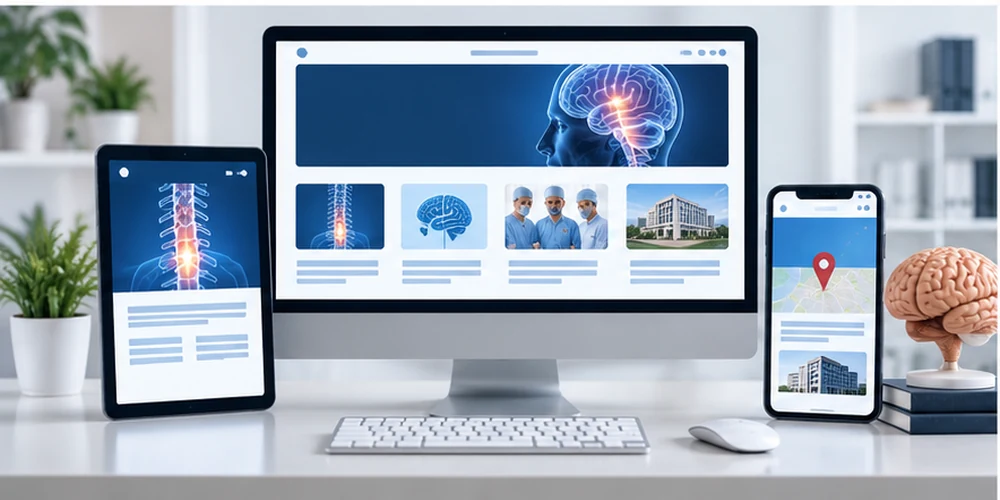
Topical authority develops through accurate coverage of the subjects a practice can explain well. A useful cluster connects the condition, relevant care options, treating clinicians, consultation locations and practical patient questions.
Brain and Cranial Care
A practice offering brain tumor consultations might connect a service overview with information about evaluation, relevant tumor types, its clinical team and second opinions. Each page should answer a separate question. Avoid implying that every brain tumor is treated with the same operation or by the same specialist.
Terminology matters. A craniotomy describes an opening in the skull; it is not another name for a particular diagnosis. The AANS neurosurgical glossary helps clarify technical terms. Patient pages should explain such language before discussing its role in the care offered.
Movement-Disorder Surgery and Other Specialized Programs
Some services need a program page because the decision involves evaluation, several clinicians, treatment and subsequent care. Deep brain stimulation is one example when it falls within the practice’s actual services.
AANS describes a multidisciplinary evaluation process that may involve a neurologist, neurosurgeon and other specialists. A service page should therefore identify the relevant team and explain the practice’s pathway, rather than presenting surgery as a single booking action.
Spine and Peripheral Nerve Services
A neurosurgery group may also provide spinal or peripheral nerve care. The website should identify the specific services and clinicians involved rather than assume that a broad neurosurgery label answers every question.
Where spinal procedures already have useful pages, connect them to the neurosurgery overview instead of creating a duplicate procedure library. Peripheral nerve topics should likewise reflect the team’s actual clinical scope, evaluation process and appointment availability.
These clusters can share surgeon biographies and location pages. The purpose is to connect useful information, not to create an isolated website section for every keyword variation.
How Should Neurology, Neurosurgery and Spine Content Fit Together?
A medical group offering several related specialties needs clear service boundaries. Neurology and neurosurgery pages should identify the relevant clinicians and appointment purposes. Shared conditions can link to more than one care pathway when the clinical relationships are accurate.
For example, a condition overview may explain the evaluation options available within the group and direct readers to the appropriate service. It should not send every visitor to a surgical consultation simply because surgery has a commercial landing page.
On one website, use a shared procedure page when the service and patient information are the same across departments. Link it from the relevant specialty hubs. Create separate pages only when there is a distinct subject or materially different information to explain.
This prevents competing copies while keeping each specialist’s role clear. It also gives referring clinicians a more reliable way to identify the right destination.
What Should a High-Intent Neurosurgery Page Explain?
A strong service page should help a reader prepare for an informed consultation. Begin with what the service involves and which clinical team provides it, then explain the details that influence the next step.
Include:
- The condition or clinical problem the page covers
- What the evaluation generally involves
- The procedure or care options being discussed
- Relevant alternatives, limitations and risks
- The surgeon’s role and any collaborating services
- Consultation locations and verified facility relationships
- Preparation and recovery information reviewed by the clinical team
- How referrals, records and appointment requests are handled
- A clear distinction between education and personal treatment advice
Answer the main question before presenting a long promotional introduction. If the page concerns a second opinion, explain how the review is arranged. If it concerns a procedure, explain the evaluation pathway before asking for an appointment.
Do not publish success rates without a source and context. Outcome statements need to identify what was measured, in which population and over what period. Avoid promising a fixed recovery or suggesting that a technology is suitable for everyone.Practices building this content can use SEO content writing services with medical review assigned to the appropriate clinician.
How Does E-E-A-T Apply to Neurosurgery SEO?
Neurosurgery information can influence significant health decisions. Experience, expertise, authoritativeness and trustworthiness matter because readers need to know who is responsible for the information and whether it is reliable. Google describes E-E-A-T as a quality framework rather than one standalone ranking factor, with particular attention to health-related topics.
A practical review process connects each important clinical page to:
- A named author and qualified medical reviewer where appropriate
- A biography establishing the reviewer’s relevant credentials
- Sources for substantive clinical claims
- Verification of the practice’s services and availability
- Accurate publication and review dates
- A person responsible for material corrections
A “medically reviewed” label should represent work that actually happened. Likewise, board certification, fellowship training, hospital affiliation and membership of a medical association should be described accurately. They are different forms of professional information.
A surgeon profile should make those facts easy to verify and connect the clinician to the services and locations shown elsewhere on the website.
How Should Neurosurgery SEO Target Dallas and Nearby Areas?

Local targeting should follow the practice’s real consultation footprint and available expertise. Research each city separately, then decide which existing pages need improvement and where useful information is missing.
Neurosurgery SEO in Dallas
Neurosurgery SEO in Dallas should connect specific expertise with a clear route into the practice. Review competing results for the service being offered, including practice pages, hospital programs and physician directories. A generic specialty description may leave unanswered questions about the surgeon, evaluation process or referral route.
Prioritize the services for which the team has both clinical capacity and a useful information gap to fill. A detailed second-opinion or specialized consultation page may serve a different need from a broad Dallas location page. Evaluate the actual results before choosing which opportunity comes first.
SEO for Neurosurgeons in Richardson
SEO for neurosurgeons in Richardson should make office-based access clear. Show the surgeons who consult there, the services available through that office, the appointment schedule and the correct contact route.
If an evaluation occurs in Richardson and a later procedure would take place elsewhere, explain that relationship. Families and referring teams should be able to identify the consultation location without interpreting a list of hospital affiliations. Keep directions, suite details and appointment information consistent across the website and local profiles.
Neurosurgeon SEO in Corsicana
Neurosurgeon SEO in Corsicana should connect the office with the particular clinicians and programs available there. A specialized service page needs to describe the team that provides the service, even when the broader organization has many physicians.
A nearby practice can explain access for Plano residents when that relationship is accurate. It should state where the consultation takes place. Organic content about serving a nearby area does not establish a physical Plano office or remove distance from Maps results.
SEO for Neurosurgeons in Kaufman
SEO for neurosurgeons in Kaufman,TX should begin with practical appointment information and current service availability. If a surgeon sees patients on selected days, keep those details accurate. Explain how to arrange evaluation, submit a referral and confirm where subsequent care occurs.
Ennis should not be labeled an easy market based only on city size. Review the specific queries, competing providers and available consultation capacity. References to nearby communities such as Waxahachie or Palmer should describe a real patient-service relationship, not imply additional offices.
A healthcare SEO expert in Lahore can coordinate research, website improvements and reporting remotely while the Texas practice verifies clinical information and local operations.
What Should Local Profiles and External Listings Show?
Google’s local results mainly depend on relevance, distance and prominence. Complete business information helps establish relevance, proximity affects which searchers see the practice, and reputation contributes to prominence. These factors make accurate local representation essential.
Use eligible profiles for real offices and practitioners. Google’s practitioner guidance requires a public-facing role and direct contactability at the verified location during stated hours. It also provides different arrangements for several practitioners sharing an office and a solo practitioner representing a brand. Do not create separate profiles for each specialization.
Keep names, phone numbers, hours, appointment links and locations accurate across the practice website and important listings. Check hospital biographies and other clinical directories for outdated offices or affiliations. A patient should not find three different accounts of where the same surgeon sees new patients.
Request reviews neutrally and handle public replies carefully. Do not confirm a treatment relationship or discuss medical details in a response.
Which Technical and On-Page Issues Should Be Fixed First?
Prioritize the problems that stop a useful page from appearing correctly or prevent someone from reaching the practice. A technical audit should identify the affected URL, the reason it matters and the appropriate correction.
| Check | What the practice needs |
| Page intent | A clear purpose for each service, program, surgeon and location page |
| Titles and headings | Descriptive wording that matches the page’s actual subject |
| Indexing | Important public pages accessible to search engines without accidental restrictions |
| Canonical URLs | Consistent preferred versions of duplicate or very similar content |
| Internal links | Crawlable connections between services, clinicians and offices |
| Mobile usability | Readable text, usable navigation and visible contact actions |
| Forms and referrals | Clear labels, understandable errors and working submission routes |
| Structured data | Accurate information matching the visible page |
For example, a Dallas brain tumor consultation page should clearly identify the service, the treating team and the consultation location. Its title should describe those facts. It should not list every neurosurgical procedure or nearby city simply to expand keyword coverage.
Review a suspected overlap before consolidating pages. Two useful pages mentioning the same condition do not automatically compete. The issue is whether they serve the same decision with substantially duplicated information.
Structured data can help describe the organization, office, page author and other visible entities. It does not verify credentials or guarantee a special search result.A medical practice SEO audit can bring these checks into one prioritized review.
How Can Neurosurgery Content Work Better for AI and Voice Search?
Write answers that are clear enough for a patient or referring clinician to use immediately. Google says its generative search features build on established SEO practices and do not require special AI files or an exclusive schema type. No formatting method guarantees selection.
Useful questions include:
- Which surgeon evaluates this condition?
- Where can I request a neurosurgery second opinion?
- What records does this practice need before scheduling?
- Does the Richardson office offer this consultation?
- How does a referring clinician contact the team?
Give the direct answer first, then add relevant qualifications. Identify the service, clinician and location explicitly where that improves clarity. Keep important information in visible text, use sources for medical claims and connect each answer to the relevant next page.
AEO, GEO and voice-search work should improve understanding. Avoid filling the site with slightly reworded answers or replacing clinically accurate explanations with oversimplified snippets.
Make Patient Requests and Clinical Referrals Easy to Complete

A neurosurgery website should provide clear routes for new patients, referring clinicians and existing patients. Combining them in one vague contact form can create avoidable confusion for both visitors and staff.
| Visitor | Appropriate route | Information that helps |
| New patient or family member | Consultation request | Relevant service, actual office, contact details and what happens next |
| Referring clinician | Approved referral process | Records requirements, secure submission method and referral-team contact |
| Existing patient | Practice-approved clinical contact or portal | A clear route for established-care questions |
Explain which documents the team needs and how to provide them securely. Do not require the same information repeatedly across several disconnected forms. If scheduling depends on a referral or review of records, explain that before the request is submitted.
State a response timeframe only when the practice can maintain it. A form confirmation should distinguish receipt of a request from confirmation of an appointment.
Protect the information moving through these systems. Review scheduling, analytics, call tracking and referral vendors according to the data they receive. HHS guidance concerns disclosures of protected health information and includes a court ruling limiting part of its public-webpage interpretation. Avoid assuming that a consent banner, server-side tracking or a vendor’s marketing claim establishes compliance.
Measure Qualified Access to Care, From Inquiry to Attendance
Neurosurgery SEO reporting should connect relevant visibility with the practice’s intake process. A submitted form, a complete referral, a scheduled appointment and an attended consultation are different events.
| Stage | Example measurement | What it reveals |
| Search visibility | Relevant procedure, provider and location impressions | Whether the practice appears for suitable searches |
| Initial inquiry | Answered calls and valid appointment requests | Whether visitors reach the team |
| Referral completion | Required records received through the approved process | Whether an inquiry can move forward |
| Clinical routing | Referral directed to the appropriate team | Whether the pathway matches available expertise |
| Scheduling | Confirmed new-patient appointments | Whether the request becomes a consultation |
| Attendance | Completed consultations by office and source | Whether patients reach the scheduled visit |
Keep clinical routing in the appropriate clinical workflow. Website analytics should not attempt to decide whether someone needs surgery.
Record referral origin separately from the channel used to contact the practice. A physician-referred patient may use Google to locate the office. Search helped the person reach the team, but reporting all such appointments as newly acquired organic patients would overstate the channel’s contribution.
Review results by active location, service and surgeon. Use aggregate reporting where possible and keep clinical details within approved systems. If a page gains traffic without suitable inquiries, investigate intent, availability and the intake route before producing more content.
What Should a Neurosurgery SEO Budget Cover?
A useful budget pays for defined work: technical corrections, priority service pages, surgeon biographies, location accuracy, clinical review coordination and meaningful reporting. The scope depends on the starting website and the number of services, providers and offices involved.
Request a proposal that identifies what will be improved, who will implement it and who supplies medical approval. Avoid comparing retainers solely by article count. The medical SEO cost guide explains wider budgeting considerations.
If the practice needs additional demand while organic work develops, evaluate paid search against available appointment capacity and the quality of the landing experience. This comparison of healthcare SEO and Google Ads explains the different roles of the two channels.
Timelines should follow the work required. Fixes can be completed before search performance changes, and stronger visibility does not immediately translate into attended consultations. Review implementation, relevant inquiries and scheduling outcomes over time instead of relying on a universal ranking deadline.
A 90-Day Neurosurgery SEO Plan
| Period | Priority | What should be ready for review |
| Days 1–30 | Confirm clinical scope, locations, current pages and referral routes | A capabilities record, baseline reporting and a prioritized page plan |
| Days 31–60 | Improve priority service pages, surgeon profiles, local information and technical access | Accurate pages and working patient and referral pathways |
| Days 61–90 | Add useful patient questions, connect related pages and evaluate intake outcomes | Evidence of what to improve next by service and location |
Sequence the work around the practice’s largest current obstacle. If referrals are arriving but cannot be scheduled because records are missing, improve that process. If the right clinical service is absent from the website, build its page. If an office is misrepresented online, correct its information before promoting it.
The next quarter should follow the evidence from these changes, including the team’s ability to handle appropriate consultations.
What Should You Expect From a Neurosurgery SEO Provider?
A provider should explain the relationship between the practice’s expertise, its website and its intake goals. Ask for a clear reason behind each priority, a workable medical review process and reporting that distinguishes visibility from attended care.
Useful questions include:
- How will the content reflect the services our clinicians actually provide?
- Which existing pages should be improved or consolidated?
- How will patient and referring-clinician needs be handled?
- Who verifies locations, credentials and medical claims?
- How will the practice retain access to its website, profiles and reporting?
Waseem Marketing Expert’s healthcare SEO portfolio includes projects involving pain management, mental healthcare and other medical services. Review the relevance and scope of any provider’s previous work rather than assuming that a broad healthcare label establishes experience with every subspecialty.Practices seeking a Medical SEO Expert in Pakistan can discuss their website, referral process and Texas target markets with Waseem Marketing Expert.
Frequently Asked Questions
Can a Spine-Focused Neurosurgeon Rank Without Brain Surgery Content?
Yes. Content should reflect the surgeon’s actual expertise and services. A spine-focused practice can build a useful site around relevant conditions, procedures, consultations and locations. Adding brain surgery pages for services it does not provide creates an inaccurate impression of the practice.
Does Every Neurosurgeon in a Group Need a Separate Website?
No. A shared practice website can give each surgeon a detailed biography connected to their services and offices. A separate website may make sense for a distinct business, but it also introduces additional content, maintenance and ownership decisions. Decide from the actual practice structure.
Can One Website Target Dallas, Richardson, Plano and Ennis?
Yes, provided the content explains the practice’s real relationship with each market. Use detailed pages for actual consultation offices and honest information about access from nearby areas. Different city names alone are not enough to justify multiple nearly identical pages.
Why Might Traffic Increase Without More Consultations?
The additional traffic may concern services the practice does not offer, early research questions or locations it cannot serve. Other causes include unclear contact routes, missed calls, incomplete referrals or limited appointment availability. Review the landing pages and intake outcomes together to identify the actual problem.
Does Neurosurgery SEO Require Backlinks?
Relevant content, accessible pages, accurate profiles and credible clinicians create a strong foundation. Competitive searches may also benefit from earned links and legitimate external references. Focus on accurate affiliations, useful resources and trustworthy mentions rather than bulk links or fabricated endorsements.
Can an Agency Guarantee More Surgical Cases From SEO?
No. Search performance varies, and the need for surgery is a clinical decision. A responsible campaign should improve relevant visibility and access to qualified consultations while reporting the limits of attribution. Procedure decisions must remain with patients and their clinical teams.
Build Visibility Around the Expertise Patients Need
Neurosurgery SEO is most useful when it helps patients and referring clinicians reach the appropriate specialist. Make the practice’s clinical scope clear, connect procedures to the right surgeons, explain local access and provide a workable consultation process.
For practices serving Dallas, Richardson, Plano and Ennis, growth should begin with the services and offices ready to receive suitable inquiries. Waseem Marketing Expert’s SEO services cover website audits, keyword mapping, content strategy and local visibility. Share your website and priority services to discuss a practical search plan.