What is a P2P network, and why can it operate without depending entirely on one central server? In this networking model, participating computers or devices can connect with other participants and share files, storage, bandwidth, processing capacity, or other resources. Each device may receive data, provide it, or perform both roles during the same session.
This design appears in local computer networks, internet file distribution, blockchain systems, distributed computing, and some communication applications. It can reduce reliance on central infrastructure, but it also changes how administrators handle performance, access, security, and troubleshooting.
What Is a P2P Network?
A peer-to-peer network is a computer network in which participating devices, called peers, exchange data or resources with one another. A peer may act as both a requester and a provider. Some implementations operate without a permanent central server, while hybrid systems use central services for discovery, indexing, authentication, or coordination.
Unlike a traditional client that only requests services from a server, a P2P participant can serve resources to other devices. It does not need to connect with every participant; protocol rules, firewalls, availability, and application design determine its connections.
What Does P2P Mean?
P2P stands for peer-to-peer. A peer is a computer, phone, server, application instance, or other node that participates in the network. Depending on the system, it can request a resource, provide one, forward network information, validate data, or contribute computing capacity.
Comparable networking roles do not mean equal capacity. Peers may have different bandwidth, storage, processing power, and availability. They can communicate through TCP/IP, QUIC, WebRTC, discovery protocols, and application-specific rules. P2P describes their architectural relationship, not one required transport protocol.
What Is a Peer in Networking?
A peer is an active participant that may consume and supply resources. A laptop can open a shared folder on another computer while making its own printer available to approved devices. On a global system, it may download file segments while uploading pieces it already has. The word node also means a connected device or software instance and often refers to the same participant.
How Does a P2P Network Work?
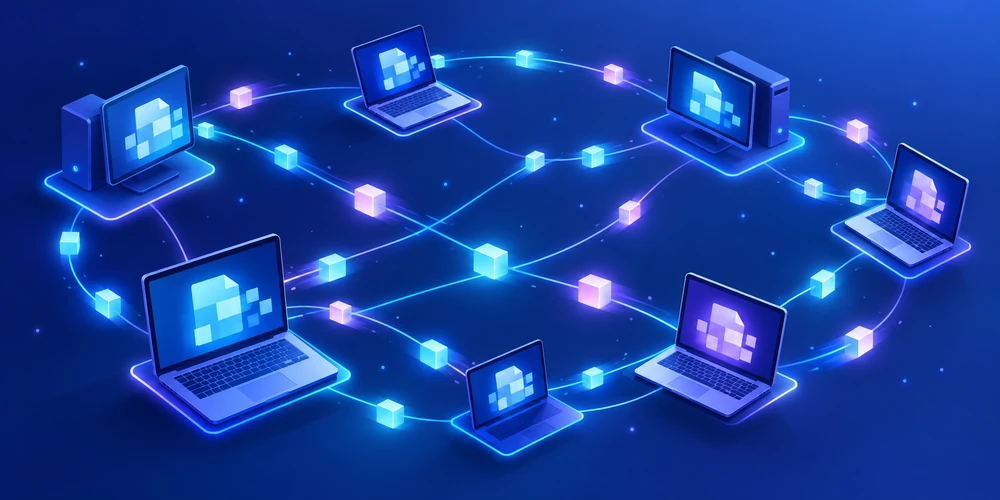
A peer-to-peer system allows devices to locate one another, establish connections, and exchange resources under a shared protocol. Some systems use a central directory or tracker to help peers find each other, while others use distributed discovery methods such as a distributed hash table.
A typical flow looks like this:
- A device joins the network. It starts compatible software and obtains the information needed to contact one or more participants.
- The device identifies itself as a peer. The protocol may exchange an address, peer identifier, capability details, or authentication data.
- The peer locates resources or other peers. Discovery may use a central tracker, known bootstrap nodes, local broadcasting, peer exchange, or a DHT.
- Peers establish connections. Network rules determine how participants negotiate communication, permissions, and encryption.
- Resources are exchanged. Files, file segments, storage, bandwidth, messages, or processing work can move between peers.
- Peers join and leave. The network must handle changing availability and find alternative sources when a participant disconnects.
If computer A requests a large file, it may receive different sections from computers B, C, and D while uploading received sections to another participant. Firewalls and network address translation can complicate direct connections, so some systems use connection negotiation or relays without turning the whole design into a traditional client-server network.
Types of P2P Networks
P2P systems can be grouped by their reliance on central services and by the way peers and resources are organized.
Pure P2P Networks
In a pure design, the main operation does not depend on a permanent central server. Peers handle discovery, communication, and resource exchange through distributed methods. This can reduce a central failure point but make administration harder, and nodes can still differ in capacity or authority.
Hybrid P2P Networks
A hybrid network uses central infrastructure for accounts, authentication, indexing, or discovery while data travels between peers. This simplifies coordination without making the server deliver every resource. If it fails, current transfers may continue even though new peers have trouble connecting.
Structured P2P Networks
Structured networks use defined lookup rules. A distributed hash table, or DHT, maps a resource identifier to peers that know about or store it. Lookup information is distributed among participants, making searches more predictable while requiring routing updates as peers join or leave.
Unstructured P2P Networks
An unstructured network has no strict global lookup arrangement. Searches may pass among neighboring peers until a resource or search limit is reached. This can adapt to changing participation but may use more traffic to locate rare resources.
P2P Network vs Client-Server Network
A peer-to-peer network allows participating devices to provide and consume resources, while client-server architecture normally assigns central servers to provide services to client devices. Neither approach is automatically better; the right choice depends on control, scale, reliability, security, cost, and application needs.
| Feature | P2P Network | Client-Server Network |
| Architecture | Resources are distributed among peers | Services are centered on one or more servers |
| Participant role | A device may request and provide resources | Clients request; servers provide |
| Central server | May be absent or used only for coordination | Usually required for the core service |
| Control | Distributed or shared across participants | Central administration is common |
| Resource capacity | Can grow as suitable peers contribute | Grows through server infrastructure |
| Security management | More difficult across changing peers | Central policies are easier to apply |
| Availability | Depends on peer participation and design | Depends on server capacity and redundancy |
| Maintenance | Updates may need coordination across peers | Central components can be updated directly |
| Typical uses | File distribution, blockchain, distributed work | Websites, databases, email, business applications |
Client-server design centralizes accounts, policies, storage, and logs. P2P distributes activity but can complicate oversight. Many applications combine both patterns.
P2P Network Examples

Real systems use peer-to-peer networking in different ways. Some distribute files, some propagate records, and others divide computing work.
BitTorrent
BitTorrent divides data into pieces. A participant can obtain different pieces from several peers and upload available pieces to others. The group sharing the same content is a swarm.
A seeder has the complete file and continues uploading. A leecher is usually still downloading but may upload at the same time. Trackers help peers find one another, while DHT and peer exchange can reduce reliance on a tracker.
BitTorrent is a protocol, not a synonym for piracy. It can distribute open-source software, public datasets, and authorized media. Legality depends on the content, permission, and applicable law.
Blockchain Networks
Many blockchain systems use P2P communication to propagate transactions, blocks, and network status under their own validation and agreement rules.
Blockchain and P2P are not the same technology. Peer-to-peer describes how participants communicate, while blockchain is a distributed ledger structure that can use peer networking. A P2P application does not need a blockchain, and a blockchain includes far more than device-to-device communication.
Distributed Computing
Distributed computing divides a large job among devices that contribute processing capacity. Central coordination may still assign work or verify results, making the system hybrid.
Communication and Content Distribution
Some voice, video, messaging, gaming, and content systems connect users directly when possible. Relays may still be needed when firewalls or routing conditions block those connections.
What Is a P2P Network Used For?
Common use cases include:
- Sharing files or file segments across many devices
- Distributing software packages or large public datasets
- Propagating blockchain transactions and blocks
- Contributing processing capacity to a shared computing task
- Sharing storage or bandwidth across approved participants
- Supporting direct voice, video, messaging, or gaming connections
- Synchronizing data among devices in certain distributed applications
A home setup may let trusted computers share folders and printers. An internet-scale system must also handle identity, discovery, routing, encryption, untrusted peers, turnover, and varying speeds.
Advantages of Peer-to-Peer Networking
The potential benefits depend on the protocol and use case.
- Shared resources: Participants can contribute storage, bandwidth, files, or processing capacity.
- Reduced central workload: Data exchange between peers can lower demand on a central delivery server.
- Capacity growth: In some systems, more qualified participants add useful resources rather than only increasing demand.
- Resilience: A service may continue when one peer disconnects if the same resource is available elsewhere.
- Direct communication: Devices may exchange data without routing every transfer through an application server.
- Lower infrastructure needs: Some workloads can use participant resources instead of placing all capacity in central infrastructure.
These benefits require enough reliable participants and resource copies. Adding slow or malicious peers does not improve performance.
Disadvantages of P2P Networking
Distribution creates operational tradeoffs that a centralized system may avoid.
- Harder administration: There may be no single dashboard for permissions, updates, logs, and troubleshooting.
- Variable availability: A resource may disappear when the peers providing it disconnect.
- Uneven performance: Participants have different bandwidth, hardware, network paths, and uptime.
- Security exposure: Devices may communicate with unknown or compromised peers.
- Data consistency: Multiple copies or updates can require conflict-resolution rules.
- Access-control challenges: Enforcing organization-wide policies across many devices can be difficult.
- Peer dependence: The system may perform poorly when too few participants contribute resources.
- Complex debugging: Problems can involve discovery, routing, local firewalls, software versions, or remote peers.
Are P2P Networks Secure?
P2P architecture is not automatically secure or insecure. Safety depends on protocol design, encryption, authentication, peer verification, permissions, integrity checks, software quality, and user behavior.
Risks include malware, untrusted peers, exposed data, visible IP addresses, weak authentication, and outdated applications. A harmful file can still pass a check showing that its pieces match the originally shared data.
Defensive practices include:
- Use trusted, maintained software
- Install security updates promptly
- Verify file origin and integrity
- Apply appropriate firewall and access rules
- Use strong authentication when supported
- Encrypt sensitive communication and stored data
- Limit shared folders and permissions
- Follow organizational data and device policies
- Monitor unusual network activity
Corporate security teams may restrict P2P traffic when direct connections conflict with governance, logging, or data-loss controls. Such a policy reflects organizational risk requirements rather than proving every protocol unsafe.
Is P2P the Same as Decentralization?
P2P and decentralization are related but not identical. P2P describes communication or resource exchange among peers. Decentralization may refer to control, governance, infrastructure, decision-making, or data ownership.
A hybrid P2P system may use a central login service, directory, or policy authority while transferring data between peers. It uses peer communication but retains centralized elements. A decentralized organization may also distribute authority through several servers or operators without allowing end-user devices to communicate directly.
To assess decentralization, ask who controls identities and rules, where data resides, who approves records, and which services the network requires.
When Should a Business Use a P2P Network?
Peer architecture may fit when participants can contribute useful resources, direct communication is valuable, and the application benefits from distributed capacity. File distribution, device-to-device collaboration, content delivery, distributed computing, and certain blockchain applications may support this model.
It may be a poor fit when the business requires strict central access control, predictable device availability, simple auditing, uniform updates, or tightly governed storage. Sensitive industries may also require central administration and documented data locations.
Before selecting an architecture, evaluate:
- The resource being shared
- The trust level between participants
- Expected peer availability
- Security and privacy requirements
- Data ownership and retention rules
- Network and firewall restrictions
- Performance and latency targets
- Monitoring and support capacity
- The effect of coordination-service failure
Many practical products combine central account management with direct transfers. A hybrid architecture can preserve useful peer communication while keeping selected controls centralized.
How P2P Technology Fits a Digital Business
A company building a browser-based communication tool, file-sharing product, distributed dashboard, or technology platform needs more than the networking layer. User accounts, interfaces, permissions, monitoring, error handling, and support workflows must connect with the underlying protocol. Professional website development services can support the customer-facing platform and its approved integrations.
Technical businesses must also explain difficult concepts without confusing potential users. Clear technology content writing services can turn product architecture, security practices, and use cases into understandable website pages and guides. An SEO marketing expert can connect those resources with actual customer questions, while focused SEO services can improve site structure, internal linking, search intent alignment, and organic visibility.
Companies evaluating how a technical product should be presented online can request a digital marketing consultation to discuss website structure, educational content, search demand, and lead measurement.
Frequently Asked Questions
What Is a P2P Network in Simple Terms?
It is a network where participating devices can exchange resources with one another. A device may download information, upload it, or do both. Some P2P systems avoid a permanent central server, while others use central services for discovery or account management.
What Does P2P Stand For?
P2P stands for peer-to-peer. A peer is a device or application instance that participates in the network and may request, provide, forward, store, or validate resources according to the protocol.
What Is an Example of a Peer-to-Peer Network?
BitTorrent is a common example. It allows participants to download different pieces of a file from multiple peers while uploading pieces they already hold. Many blockchain networks also use peer communication to propagate transactions and blocks.
How Does Peer-to-Peer File Sharing Work?
Software divides or identifies data in transferable pieces, locates peers that have those pieces, verifies received data, and reconstructs the complete file. Discovery can use trackers, DHTs, peer exchange, or a combination of methods.
Is Blockchain a P2P Network?
Many blockchains use a P2P network for node communication, but blockchain and P2P are not the same. P2P is a networking model. Blockchain is a distributed ledger technology with rules for storing, validating, and agreeing on records.
What Is the Difference Between P2P and Client-Server Networking?
In client-server networking, clients normally request services from central servers. In P2P networking, participants can both provide and receive resources. Hybrid systems combine centralized coordination with direct peer exchange.
Are Peer-to-Peer Networks Legal?
P2P technology is legal in itself. Legality depends on what users share or do, whether they have permission, and which laws apply. Distributing copyrighted material without authorization may be illegal even though the underlying protocol has legitimate uses.
What Are the Main P2P Security Risks?
Risks include untrusted peers, malicious files, exposed data, weak authentication, visible network addresses, outdated software, and inconsistent device security. Trusted software, updates, access controls, encryption, verification, and monitoring can reduce risk.
Final Thoughts
Peer-to-peer networking allows devices to share data or capacity without routing every interaction through one central service. That architecture can distribute workload, use participant resources, and support direct communication, but it can also make security, availability, control, and troubleshooting more difficult.
The best decision depends on the resource, participants, trust model, compliance needs, and operating environment. Pure, hybrid, structured, and unstructured designs solve different problems. Understanding these differences helps businesses and technical teams choose an architecture based on real requirements rather than assuming that centralized or decentralized technology is always superior.