A patient with sudden tooth pain is not casually browsing. They check which dentist is close, open, well reviewed and easy to call often without moving past Google Maps. A parent choosing a pediatric dentist or an adult comparing dental implants takes longer, but the same decision signals still matter: clear services, a credible team, useful answers, accurate business details and a simple appointment path. Local SEO for dentists connects those signals so a dental practice can appear at the right moment and turn nearby searches into real patient enquiries.
The short answer is this: a dental practice improves its local search visibility by making its Google Business Profile and website agree about who it serves, where it is located and which treatments are available. Authentic patient reviews, trusted local mentions, technically sound pages and a low-friction booking experience strengthen that foundation. If you need help joining these parts into one roadmap, my SEO services in Pakistan cover website, content and Google Maps visibility as one system.
No ethical consultant can guarantee the number-one Map Pack position. Google says local results are mainly based on relevance, distance and prominence, and every patient may see a different order based on location and query. The goal is to improve the signals you control, measure appointments rather than vanity rankings, and keep the practice accurate enough to earn both visibility and trust.
What Is Local SEO for Dentists?
Local SEO for dentists is the process of helping a dental office appear when people search for care in a specific area. It covers Google Search, Google Maps, the Local Pack, online directories, review platforms and the clinic’s own website.
Examples of local dental searches include:
- Dentist Near Me
- Family Dentist In [City]
- Emergency Dentist Open Now
- Dental Implants In [City]
- Pediatric Dentist Near [Neighborhood]
- Invisalign Provider In [City]
- Dentist Accepting [Insurance Plan]
- Same-Day Tooth Extraction Near Me
These searches do not all belong on one page. A person seeking emergency treatment needs hours, a phone number and immediate next steps. Someone researching implants needs candidacy information, the treatment process, financing and evidence of clinician experience. A strong dental local SEO strategy maps each intent to the right Business Profile field, treatment page or location page.
Why Dental Local SEO Needs Its Own Strategy
Dentistry combines local intent, health-related trust and high-consideration services. That creates four challenges that a generic local business checklist can miss.
First, distance matters. A clinic cannot add a list of surrounding cities to its website and expect Google to treat it as physically close to every searcher. Second, a practice may have a business profile, profiles for eligible public-facing dentists, or both. Poor profile structure can split signals or create duplicates. Third, reviews influence patient choice, but a clinic must protect patient privacy when it replies. Fourth, a ranking is only useful if the page or profile makes it easy to call, check insurance, request an appointment or get directions.
That is why dental SEO should be measured in qualified calls and booked patients not only impressions, clicks or one screenshot of a ranking.
How Google Ranks Dentists in Local Results
Google’s official local-ranking guidance names three main factors.
Relevance
Relevance is how closely the clinic matches the patient’s search. The primary category, secondary categories, services, website content and other business details help Google understand whether a profile is a suitable result for “pediatric dentist,” “periodontist” or “emergency dentist.”
Improve relevance by accurately describing the services the practice really provides. Do not add categories for treatments that are not available at that location. Do not put search phrases into the business name unless they are part of the real-world name used on signage and official materials.
Distance
Distance is the space between the searcher and the dental office, or between the office and the location named in the search. You cannot directly optimize away a poor location match.
A useful location page can rank organically for a nearby area when it provides real value, but it does not move the practice’s verified map pin. Before blaming an SEO campaign, check rankings from multiple points on a local grid. A clinic may be visible within two miles and weak eight miles away simply because closer competitors become more relevant.
Prominence
Prominence reflects how well known and trusted a business appears. Google says links, reviews and information from around the web can contribute. Strong organic visibility can support local visibility as well.
For a dental practice, prominence may be reinforced by authentic reviews, accurate professional profiles, local media coverage, dental association listings, community partnerships and useful website content. This is where wider local SEO for small businesses supports the clinic’s Google Maps work.
Step 1: Audit the Local Search Results Before Editing Anything
Search from the clinic’s real service area and record what Google shows for the terms that matter. Use an incognito browser only as a rough check; it does not remove location effects. A local rank-grid tool gives a better view of visibility around the office.
Build a simple audit sheet with:
- Query And Patient Intent
- Map Position From Several Nearby Points
- Organic Position
- Competitors In The Local Pack
- Competitor Primary Category
- Review Count, Rating And Recent Review Pattern
- Page Linked From Each Competitor Profile
- Visible Hours, Appointment Link And Services
- Next Action For The Clinic
Audit brand searches separately from non-brand searches. Ranking for the clinic’s exact name proves that Google recognizes the entity; it does not prove the clinic ranks for “dentist near me” or treatment searches.
Also compare conversion details. A competitor may rank below you but win more patients because it shows evening hours, a direct booking button, clear insurance information and real office photos.
Step 2: Set Up the Right Google Business Profile Structure
The practice should claim, verify and protect every eligible profile. Use an organization-owned Google account as the primary owner, add trusted managers separately and keep recovery details current.
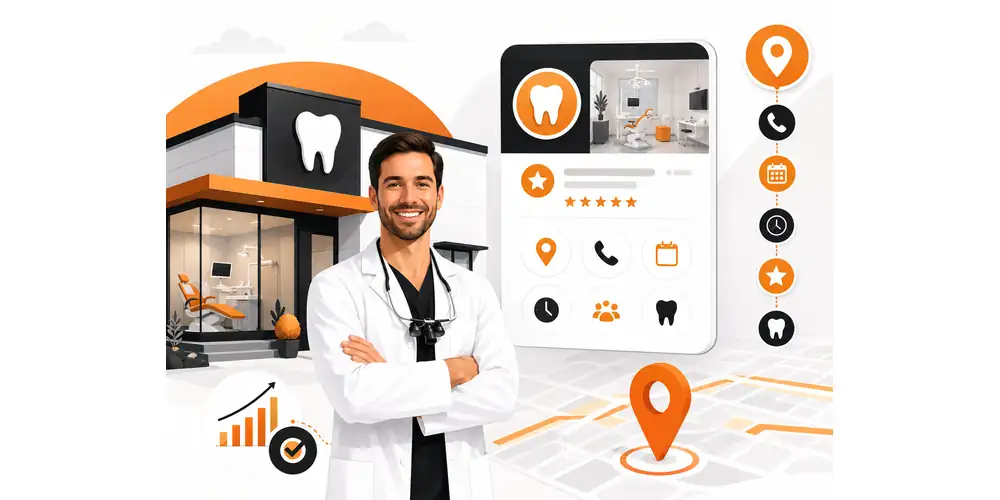
The business name must match the name used in the real world. Avoid names such as “Best Emergency Dentist and Dental Implants in Austin” unless that is genuinely the registered and publicly displayed name. Keyword-stuffed titles risk edits or profile restrictions.
Practice Profile Or Individual Dentist Profile?
Google treats dentists as individual practitioners. Its Business Profile guidelines say a public-facing practitioner may have a dedicated profile when the professional has their own customer base and can be contacted directly at the verified location during stated hours.
Use these rules as a decision guide:
- Solo dentist with one branded practice: start with one accurate profile unless there is a clear reason for a separate eligible entity.
- Several dentists at one office: the practice can have its own profile, while eligible public-facing practitioners may have individual profiles.
- Different specialists at one address: distinct practitioner categories can help Google and patients understand each clinician’s role, provided each profile follows the rules.
- Support staff or hygienists without an independent public-facing practice: do not create profiles only to gain extra map coverage.
Do not create multiple profiles for one dentist’s different services. Do not use practitioner listings to manufacture extra locations. If duplicate or old profiles exist, review ownership and merge or removal options before making broad changes.
Multi-Location Dental Groups
Each genuine, staffed location that sees patients can have its own profile. Link every profile to the matching location page not automatically to the chain’s homepage. Each office needs accurate hours, phone, appointment path, images, services and local review activity.
Virtual offices, rented mailboxes and unstaffed spaces are not shortcuts to wider Maps coverage. A false location creates suspension risk and a poor patient experience.
Step 3: Choose Categories and Services Based on Reality
The primary category should describe the location’s main business as specifically as Google allows. For a general dental office, “Dentist” is often the logical choice. A specialist practice may be better represented by “Orthodontist,” “Pediatric Dentist,” “Periodontist” or another available category.
Secondary categories should represent services that patients can actually receive at that location. Avoid adding every dental category simply because a competitor uses it. Category availability and names can vary by country, so check the options inside the profile.
Then complete the service list. Group services in language patients understand, such as:
- Dental Exams And Cleanings
- Fillings And Crowns
- Emergency Dental Care
- Root Canal Treatment
- Tooth Extraction
- Dental Implants
- Dentures
- Veneers And Teeth Whitening
- Children’s Dentistry
- Braces And Clear Aligners
Keep the descriptions factual. Mention who the service may help, what the appointment involves and how to book. Do not make medical outcome promises. If prices vary after examination, explain that instead of publishing a misleading fixed fee.
Step 4: Complete Every Patient-Decision Field
A finished profile is easier for Google to interpret and easier for a patient to trust. Check:
- Exact Practice Name
- Physical Address And Map Pin
- Local Phone Number
- Main Website Url
- Direct Appointment Url
- Regular And Special Hours
- Primary And Secondary Categories
- Services
- Accessible Entrance, Parking And Relevant Attributes
- Business Description
- Opening Date Where Applicable
Emergency hours deserve special care. Do not claim “24-hour dentist” if calls go unanswered or the office is not available around the clock. If after-hours care is limited to existing patients or on-call triage, state that clearly on the website.
Use the description to explain the practice, location, main treatments and patient groups in plain language. It is not a place to repeat every city or keyword variation.
Step 5: Add Real Photos That Reduce Appointment Anxiety
Dental patients want to know who they will meet and what the office feels like. Add recent, well-lit photos of:
- The Exterior And Entrance
- Reception And Waiting Area
- Treatment Rooms
- Dentists And Clinical Team
- Accessible Parking Or Entry
- Equipment When It Helps Explain Care
- Community Events Or Team Education
Use original images from the real location. Stock photos can make several clinics look identical and may weaken trust. Get written permission before using any patient image, testimonial or before-and-after case. Remove visible patient records, computer screens and personal information.
Upload new photos when the team, exterior or facilities change. The purpose is not to follow an arbitrary weekly quota; it is to keep the profile accurate and useful.
Step 6: Build a Policy-Safe Patient Review System
Reviews can support prominence and strongly affect which clinic a patient chooses. There is no universal review count needed to enter the Local Pack. Compare against relevant competitors, then focus on a steady process that asks real patients for honest feedback.
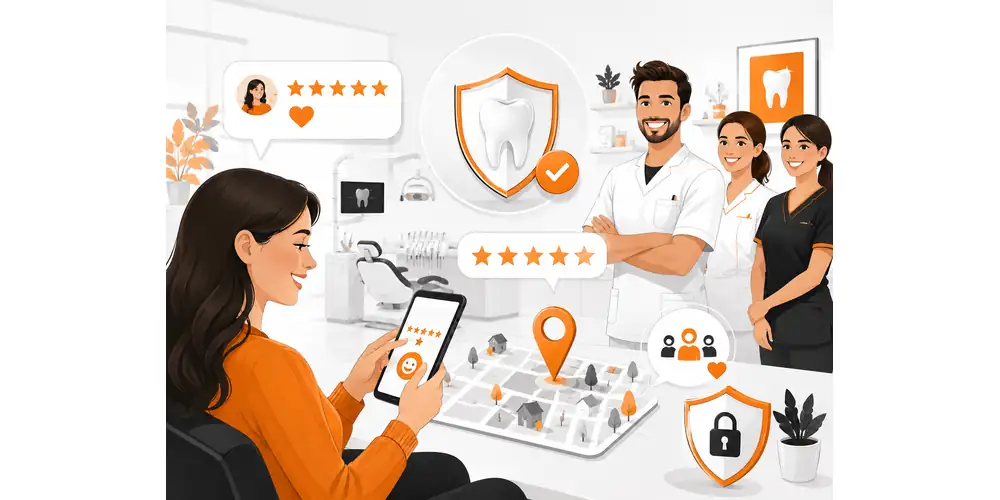
A practical workflow is:
- Ask after a completed appointment when the patient experience is fresh.
- Send the clinic’s direct Google review link by text or email.
- Make the request neutral: invite honest feedback rather than a five-star rating.
- Let every eligible patient have the same opportunity; do not screen out unhappy patients.
- Monitor reviews and reply under a documented privacy policy.
Google’s review guidance permits reminders and a direct link or QR code, but incentives for reviews are prohibited. Do not offer discounts, gifts or treatment benefits in return for positive feedback. Do not ask patients to insert treatment names or city keywords into their wording.
How Dental Clinics Should Reply Without Exposing Patient Information
For US practices subject to HIPAA, a public reply must not confirm that the reviewer is a patient or reveal treatment details. HHS has taken enforcement action against dental practices that disclosed protected health information in review responses. Use a response such as:
Thank you for sharing your feedback. We take concerns seriously, but privacy rules prevent us from discussing any individual situation here. Please contact our office manager at [phone] so we can review the matter privately.
The same restraint is sensible in other countries under their health-privacy rules. Train everyone with profile access. A well-intended reply from a front-desk employee can create legal and reputational risk.
Step 7: Create a Treatment-First Website Structure
One “Services” page rarely matches every dental search. Build a useful page for each major treatment offered by the clinic. The exact plan depends on the practice, but a general dentist may need pages for preventive dentistry, emergency care, fillings, crowns, root canals, extractions, implants, dentures, cosmetic dentistry and children’s dentistry.
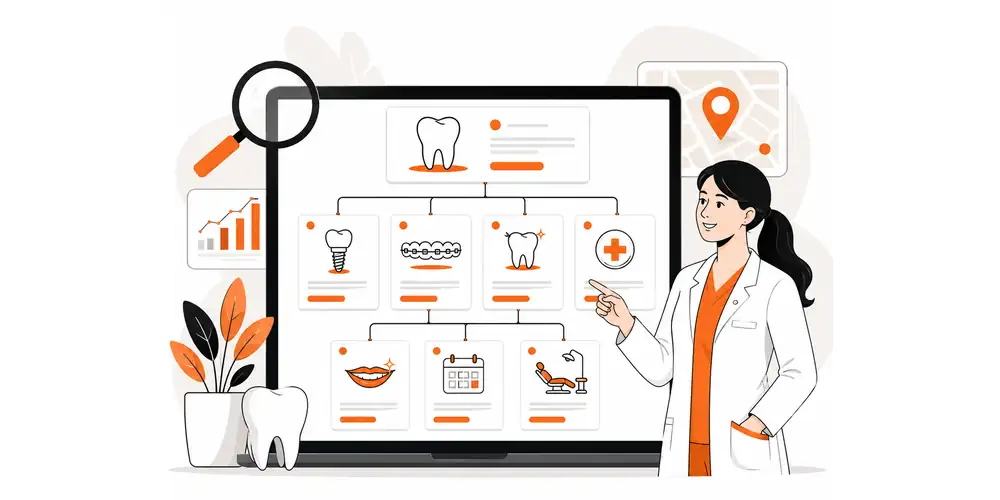
Each treatment page should answer:
- What The Service Is
- Common Reasons Someone May Seek It
- Who Provides The Care
- What Happens Before, During And After An Appointment
- Fees, Insurance Or Financing Information Where Possible
- Relevant Risks Or Limitations Reviewed By A Qualified Clinician
- Office Location And Hours
- How To Call Or Book
Add original clinician input, photos and answers based on questions the team hears every week. Because dental topics can affect health decisions, publish a named dental reviewer and a review date where medical statements are involved. My SEO content writing services can help structure these pages, but clinical claims should always be checked by a licensed dental professional.
Match The Right Keyword To The Right Page
Do not force “dentist near me,” “dental implants [city]” and “pediatric dentist [city]” onto the homepage. Map each intent:
| Patient intent | Best destination |
| dentist in [city] | location homepage or primary office page |
| emergency dentist in [city] | emergency dental care page |
| dental implants in [city] | dental implants page |
| pediatric dentist near me | pediatric dentistry page or specialist location page |
| [practice name] reviews | homepage, About page and trusted profiles |
| dentist accepting [insurance] | insurance and payment page |
| dentist open Saturday | hours/location page, only when true |
This structure gives one page a clear purpose and makes internal links more meaningful.
Step 8: Build Location Pages That Deserve to Exist
A single-location clinic normally needs one strong location page containing its address, map, directions, parking, public transport, hours, phone, appointment link, team, services and local FAQs.
A dental group should publish one unique page per physical office. Include details that genuinely differ:
- Dentists Working At That Location
- Treatments Available There
- Phone And Booking Link
- Hours And Emergency Arrangements
- Original Office Photos
- Driving Directions And Landmarks
- Accessibility And Parking
- Insurance Or Payment Details
- Reviews Or Testimonials With Permission
Avoid producing dozens of near-identical city pages for places where the clinic has no office. A page that swaps only the city name is unlikely to satisfy a patient and can dilute site quality. For nearby communities, use a carefully written service-area section only when the clinic truly attracts patients from those areas and can offer useful travel information.
Step 9: Strengthen On-Page SEO and Internal Links
Every important page needs a descriptive title, one clear H1, readable headings, a useful introduction and an obvious next action. A treatment-location title may follow this pattern:
Dental Implants in [City] | [Practice Name]
The copy should use the main phrase and related concepts naturally. A dental implants page might also discuss implant consultations, missing teeth, bone assessment, treatment stages, healing, aftercare, fees and clinician experience. Semantic coverage comes from answering the topic, not adding a list of disconnected phrases.
Use internal links to connect:
- The Homepage To Core Treatments And Office Pages
- Treatment Pages To Relevant Dentist Bios
- Educational Articles To The Treatment Page They Support
- Location Pages To Services Available At That Office
- Insurance And Financing Information To High-Consideration Treatments
- Every Booking-Focused Page To The Appointment Route
Anchor text should describe the destination. “Read about dental implant treatment” is clearer than “click here.”
Step 10: Add Accurate Dental Structured Data
Structured data helps search systems understand business facts; it does not guarantee a ranking or rich result. Use the most specific type that accurately describes the entity. Schema.org defines Dentist as a subtype of LocalBusiness and MedicalBusiness, while Google’s LocalBusiness documentation supports fields such as name, address, geo coordinates, hours, telephone and URL.
For each office, the markup should agree with the visible page and Business Profile. A basic pattern is:
{
“@context”: “https://schema.org”,
“@type”: “Dentist”,
“name”: “Example Dental Practice”,
“url”: “https://example.com/locations/city/”,
“telephone”: “+1-555-555-0123”,
“address”: {
“@type”: “PostalAddress”,
“streetAddress”: “123 Main Street”,
“addressLocality”: “Example City”,
“addressRegion”: “TX”,
“postalCode”: “75000”,
“addressCountry”: “US”
},
“geo”: {
“@type”: “GeoCoordinates”,
“latitude”: 32.00000,
“longitude”: -96.00000
}
}
Replace every placeholder, add only true properties and validate the live page. Do not mark up a star rating copied from Google as the clinic’s own review rich result. Google’s documentation limits self-serving local-business review uses.
Step 11: Make Mobile Visitors Easy to Convert
Many high-intent searches happen on a phone. Test the site from a patient’s point of view, not only with a speed score.
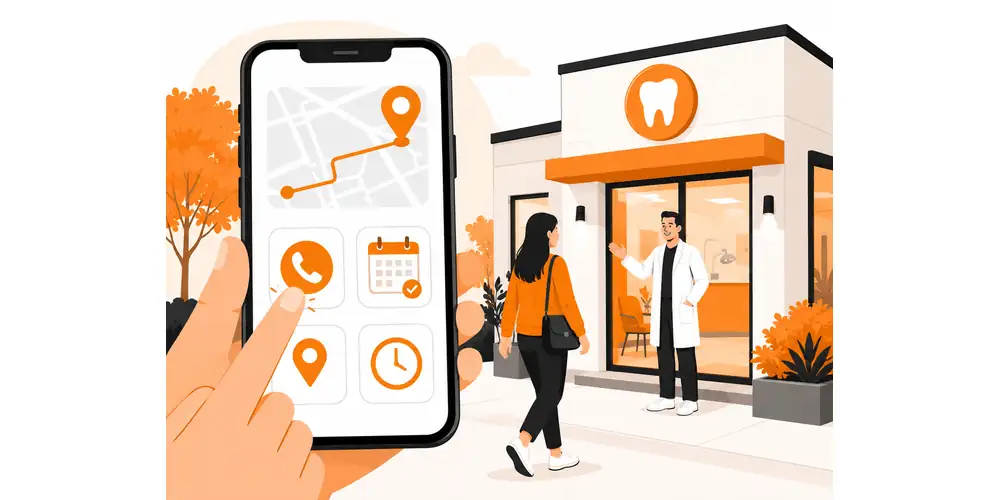
The mobile page should provide:
- A Tap-To-Call Number
- A Short Appointment Form
- An Online Booking Option That Works
- Visible Address And Directions
- Current Hours
- Emergency Instructions
- Accepted Insurance Or Payment Routes
- Readable Text Without Intrusive Pop-Ups
- Fast Loading On A Typical Mobile Connection
Ask the front desk to test each form and call path every month. A broken booking widget can waste more opportunities than a small ranking change.
Track form completion errors and unanswered calls. If patients reach the site but do not book, the problem may be slow response, unclear pricing, missing insurance information or an awkward schedule not keyword rankings.
Step 12: Clean Up Dental Citations and Entity Information
A citation is a mention of the practice and its contact details on another site. Audit major maps, healthcare platforms, dental associations, insurer directories and credible local directories used in the clinic’s country.
Check for:
- Old addresses after a move
- Disconnected phone numbers
- Duplicate practice or practitioner records
- Inconsistent business names
- Wrong hours
- Links pointing to retired pages
- Dentists shown at offices where they no longer work
Prioritize sources patients and search systems are likely to trust. In the US, this may include major map providers, Healthgrades, Zocdoc, WebMD, insurer directories and ADA or state dental association profiles. In Pakistan, the useful set may include local business platforms, healthcare directories and professional bodies. Relevance and accuracy matter more than submitting the clinic to hundreds of low-quality directories.
Use one source-of-truth spreadsheet for the official name, address, phone, URL, hours, categories and practitioner details for every location.
Step 13: Earn Local Authority Without Buying Spam Links
Google explicitly includes links in its description of prominence. A dental practice can earn useful local mentions by doing things that matter in its community:
- Join legitimate dental and business associations
- Support a local school or health event
- Provide an expert quote to local media
- Publish original community oral-health resources reviewed by a dentist
- Partner with nearby organizations on a real program
- Maintain accurate university, hospital or professional biographies
Do not buy bulk links, create fake local news sites or exchange links at scale. A relevant link from a respected local or professional source is more defensible than hundreds of unrelated directory pages.
Step 14: Publish Content Around Real Patient Questions
Use Search Console queries, recorded call themes and front-desk questions to plan content. Helpful dental topics might include:
- What counts as a dental emergency?
- How soon can a chipped tooth be seen?
- What should a new patient bring?
- Does the clinic accept my insurance?
- Are payment plans available for implants or braces?
- How long does a first appointment take?
- Does the office see children?
- Is same-day treatment available?
Do not give a diagnosis in a marketing article. Include appropriate safety language and have clinical information reviewed. Each article should link to the relevant treatment page and appointment route.
Clear question-and-answer sections can also make the clinic easier for answer engines and AI systems to understand. My guide to how Google AI Mode is changing SEO explains why concise answers, named entities and consistent evidence matter beyond the traditional ten blue links.
Step 15: Measure Rankings, Calls and Booked Patients Together
Do not judge dental local SEO with one metric. Create a monthly view that joins visibility, interaction and appointment outcomes.
Track:
- Google Business Profile views and actions
- calls from the profile and website
- appointment-form submissions
- booked appointments and qualified new-patient calls
- direction requests, interpreted cautiously
- organic clicks and queries in Search Console
- landing-page conversion rate
- rankings across a local geo-grid
- review volume, rating, recency and response status
- visibility for treatment, location and brand queries
Use UTM parameters on the website and appointment links in the Business Profile so analytics can separate profile traffic from other sources. Use a call-tracking number only when it is implemented without breaking the practice’s underlying local number and citation consistency.
Review lead quality with the front desk. A rise in “dental implants [city]” traffic is not a win if calls are outside the service area or the clinic does not offer the expected payment options. The best SEO tools for small businesses can help assemble a practical tracking stack without paying for every platform at once.
A 90-Day Dental Local SEO Plan
Days 1–30: Fix Identity And Access
- secure profile ownership and remove unknown managers
- confirm eligibility and practitioner structure
- correct the map pin, name, phone, hours and categories
- inventory duplicate or old listings
- map keywords to existing pages
- set up Search Console, analytics and conversion tracking
- test every phone, form and booking link
Days 31–60: Improve Relevance And Trust
- complete profile services and attributes
- add current office and team photos
- launch a neutral, policy-safe review request process
- correct the most important directories
- improve the homepage and priority treatment pages
- publish or rebuild the main location page
- add author and clinical reviewer details
Days 61–90: Expand Useful Coverage
- publish one or two high-value treatment pages based on real demand
- strengthen internal links and calls to action
- implement and validate Dentist structured data
- earn at least one genuine local or professional mention
- answer recurring patient questions
- compare map-grid visibility and booked-patient sources against the baseline
After 90 days, keep the work tied to evidence. If emergency searches create calls but implant pages do not, inspect the implant page, local competition, clinician proof, fees and booking path before simply publishing more articles.
Common Dental SEO Mistakes That Limit Map Visibility
Keyword Stuffing The Business Profile Name
Use the real practice name. Extra phrases may create a temporary advantage, but they also create policy and suspension risk.
Creating Fake Office Locations
A mailbox or unstaffed room does not make a valid dental office. Patients must be able to receive care at the stated location during its hours.
Treating Every Dentist Profile The Same
Practice and practitioner listings need a deliberate structure. Duplicate names, shared categories and identical landing pages can create confusion.
Copying One City Page Many Times
Changing only the city name creates weak pages. Publish location content only when it answers real questions about that office or community.
Buying Or Incentivizing Reviews
Paid, discounted or manipulated reviews violate Google’s policies. Review gating also distorts feedback and can damage trust.
Revealing Patient Details In A Reply
Never debate treatment history in public. Move complex concerns to a private channel without confirming the reviewer is a patient.
Tracking Only “Dentist Near Me”
The clinic may earn more value from emergency, implant, pediatric, cosmetic or insurance-related searches. Measure a balanced keyword set and the resulting patients.
Sending Every Profile To The Homepage
Each genuine office and specialist intent should lead to the most relevant page. That helps both the patient and the search system understand the match.
How Local SEO Changes by Dental Specialty
General And Family Dentistry
Build broad local relevance around exams, cleanings, fillings, crowns, preventive care and family appointments. Make new-patient information easy to find.
Emergency Dentistry
Accuracy and response speed are critical. Publish the real emergency hours, phone route, same-day availability and conditions the office can assess. Never claim round-the-clock care when it is unavailable.
Cosmetic Dentistry
Patients compare experience, cost, process and visual evidence. Use consented case photography, clear clinician credentials and treatment-specific pages for veneers, bonding and whitening.
Dental Implants And Periodontics
Explain the consultation, diagnostic process, stages, team expertise, aftercare and financing. Clinical review and evidence are especially important because treatment decisions can be complex and costly.
Pediatric Dentistry
Address parent concerns: first visits, age ranges, anxiety support, accessibility, insurance and emergency care. Show the real child-friendly environment rather than generic stock imagery.
Orthodontics
Create distinct pages for braces, clear aligners, retention, payment plans and consultation steps. Make it clear which options and age groups the clinic serves.
Local SEO, AI Answers and Dental Patient Choice
Patients may now ask Google AI Overviews, AI Mode, ChatGPT or Gemini to compare nearby dentists. There is no separate switch that guarantees inclusion. The same reliable entity data helps across search experiences: accurate profiles, consistent names and addresses, clear treatment pages, authentic reviews, reputable mentions and visible clinician expertise.
Write short, direct answers near the top of important pages, followed by the detail a patient needs. State the city, location, service, clinician and appointment route without forcing keywords. Keep facts aligned across the website, Business Profile, maps and professional directories.
Google’s people-first guidance says useful content should leave readers feeling they have learned enough to achieve their goal. For dental websites, that means helping a person decide what to do next not stretching a simple answer to hit a word count.
Frequently Asked Questions
How Do Dentists Rank Higher On Google Maps?
Dentists improve their chances by maintaining a verified and accurate Google Business Profile, selecting truthful categories, listing services, earning authentic reviews, publishing useful treatment and location pages, fixing citations and building local prominence. Distance still affects the results, so rankings vary by the searcher’s location.
How Long Does Local Seo Take For A Dentist?
There is no fixed timeline. Basic corrections may affect visibility after Google processes them, while competitive treatment and Map Pack growth can take months. The starting point, location, competition, website quality, reviews and authority all change the pace.
How Many Google Reviews Does A Dentist Need To Rank?
Google publishes no required number. Compare the clinic with nearby competitors, then seek honest reviews consistently. Quality, recency, rating and policy compliance matter more than chasing an arbitrary threshold.
Should A Dentist Have An Individual Google Business Profile?
An eligible public-facing dentist may have a profile when they have their own customer base and can be contacted directly at the verified office during stated hours. The setup should follow Google’s practitioner rules and avoid duplicate profiles for different services.
Should Every Dental Service Have Its Own Page?
Major treatments with distinct patient intent usually deserve individual pages when the clinic actually offers them and can provide enough useful information. Minor variations can stay within a broader service page. Page quality and purpose matter more than page count.
Does Adding City Names To A Page Improve Maps Distance?
No. Local pages may improve organic relevance when they provide genuine local value, but they do not change the practice’s physical distance from a patient or move its verified map location.
Are Google Posts Required To Rank A Dental Practice?
Google recommends keeping business information accurate and using photos and reviews, but it does not publish a required posting frequency or promise a ranking gain from posts. Use posts for useful updates, offers or office news not as a substitute for accurate profile data, reviews and strong pages.
Can A Dental Clinic Offer A Discount For A Google Review?
No. Google prohibits incentives for posting, changing or removing reviews. Ask for honest feedback without requiring a positive rating.
How Should A Dental Practice Answer A Negative Review?
Respond politely and briefly, do not confirm patient status or discuss treatment, and invite the reviewer to contact the office privately. Follow the privacy laws and professional guidance that apply in the clinic’s country.
Is Local Seo Better Than Google Ads For Dentists?
They solve different timing needs. Ads can produce visibility while the campaign is funded; local SEO builds organic and Maps visibility over time. Many practices use both, but both should be judged by qualified appointments and patient value.
Final Dental Local SEO Checklist
- verified, policy-compliant practice profile
- clear decision on practice and practitioner listings
- accurate category, services, address, hours and phone
- working appointment link and mobile call button
- real office, team and exterior photos
- neutral review requests with no incentives
- privacy-safe review response process
- unique treatment pages for core services
- one strong page for each real location
- clinician authorship or review for health-related content
- consistent citations and professional profiles
- valid Dentist or LocalBusiness structured data
- local authority from genuine organizations and media
- Search Console, analytics, call and appointment tracking
- monthly review of local-grid visibility and booked patients
Get a Dental Local SEO Audit
Local SEO for dentists works best when profile accuracy, website structure, reputation and appointment tracking follow one priority plan. Randomly adding keywords or collecting directory links cannot compensate for a weak location match, duplicate profiles or a broken booking route.
I am Waseem, a local SEO expert in Pakistan helping service businesses improve Google visibility, website structure and qualified lead tracking. You can read about my SEO background, view my Google Business Profile as a local SEO expert near me in Lahore, or request a dental local SEO audit.
The first audit should answer three questions: where can nearby patients currently find the practice, what prevents them from trusting or booking it, and which change is most likely to improve qualified appointments next? That keeps the work centered on patients and business results rather than chasing a single ranking screenshot.