A medical practice may have experienced physicians, valuable treatments and several clinic locations but still remain difficult to find when prospective patients search online. The issue is rarely one missing keyword. It is usually a disconnected website where services, conditions, doctors, locations and appointment options are not organised around real patient decisions.
Healthcare SEO for medical practices improves the website, local listings, physician information, service content and technical structure that influence search visibility. Its purpose is to help suitable patients find accurate information, verify the practice and complete an appropriate appointment step.
The strategy must connect four outcomes:
- Visibility for relevant medical and local searches
- Trust in the practice, physicians and published information
- Clear appointment and contact paths
- Measurement from search visit to qualified patient opportunity
Traffic alone cannot show whether SEO is helping a medical practice grow. The better question is whether search visibility produces relevant calls, appointment requests, scheduled visits and attended appointments.
What Is Healthcare SEO for Medical Practices?
Healthcare SEO for medical practices is the process of improving a clinic’s digital presence so search engines and prospective patients can understand:
- Which medical services the practice provides
- Which conditions its physicians evaluate or treat
- Which doctors provide each service
- Where each service is available
- Which patient groups the practice serves
- How a prospective patient can request an appointment
- Why the practice and its medical information can be trusted
The work can include technical SEO, local SEO, Google Business Profile optimization, keyword mapping, service-page improvement, physician profiles, medical content review, internal linking, structured data and patient-lead measurement.
Medical SEO is not limited to adding keywords to existing pages. It requires an accurate relationship between services, clinicians, locations and patient needs.
Why Medical SEO Requires a Dedicated Strategy
Healthcare searches can influence significant personal decisions. A person researching a symptom may need general education, while someone searching for a named procedure and city may already be comparing providers.
These two visitors should not land on the same generic page.
Medical practices also face challenges that do not appear in every industry:
- Clinical information needs accuracy and suitable review.
- Provider credentials and affiliations must remain current.
- Treatment availability can vary by physician and location.
- Local visibility depends on genuine practice locations.
- Review responses require careful privacy awareness.
- Website forms and analytics may collect sensitive information.
- Search traffic can include students, job seekers and ineligible patients.
- Rankings do not automatically produce scheduled appointments.
A successful strategy separates educational, commercial, provider and location intent while keeping the complete patient journey connected.
Build a Search-to-Patient Framework
Healthcare SEO for medical practices should measure more than rankings. A useful framework connects visibility, trust, booking and attendance.
| Stage | Main question | Relevant elements | Useful measurements |
| Visibility | Can the right person find the practice? | Service pages, local rankings, physician pages, technical access | Impressions, rankings, local visibility |
| Trust | Can the visitor verify the information? | Credentials, medical review, sources, reviews, clinic facts | Engagement, physician-profile visits, branded searches |
| Booking | Is the next step clear and functional? | Phone buttons, short forms, appointment links, location details | Calls, forms, booking clicks |
| Scheduling | Did the inquiry become an appointment? | Front-desk workflow, source recording, service eligibility | Qualified inquiries, scheduled visits |
| Attendance | Did the patient attend the appointment? | Reminders, intake process, correct location information | Attended new-patient visits |
This structure helps a practice identify where patient opportunities are being lost. A visibility problem needs a different solution from a broken form or missed front-desk call.
Begin With Patient Acquisition Priorities
SEO priorities should reflect the services and locations that matter to the practice.
A psychiatry practice promoting medication management requires a different content structure from a pain clinic targeting interventional procedures. A surgery center may need separate information for patients, surgeons and referral offices. A multi-location group must also show which physicians and services are available at each office.
Before creating new pages, document:
- Priority services and procedures
- Conditions connected to those services
- Physicians providing each service
- Genuine consultation locations
- Treatment availability by location
- Patient groups served
- Insurance or payment information
- Current appointment capacity
- Actions that count as qualified inquiries
This information becomes the foundation for keyword research, page planning and conversion measurement.
Map Keywords to Patient Intent

Keyword volume does not reveal the complete value of a search. A smaller treatment-and-location query may be more commercially relevant than a broad medical term receiving thousands of searches.
| Search intent | Example query | Best page type | Primary goal |
| Symptom research | Why does my lower back hurt? | Clinician-reviewed article | Explain possible causes without diagnosing |
| Condition research | Sciatica treatment options | Condition page | Explain the condition and related care paths |
| Treatment research | How does radiofrequency ablation work? | Treatment page | Explain the procedure and evaluation process |
| Provider comparison | Pain management doctor near me | Physician and location page | Verify expertise and local access |
| Local service intent | TMS therapy in Richardson | Treatment page connected to a real location | Confirm availability and appointment route |
| Cost or coverage | Is TMS covered by insurance? | Insurance or patient-information page | Explain verification steps |
| Branded navigation | Clinic name phone number | Homepage, contact page and local profile | Provide direct contact information |
| Appointment intent | Psychiatrist accepting new patients | Location or service page | Make contact simple |
One primary intent should be assigned to every important URL. Related wording can share the same page when the visitor is making the same decision.
Create a Clear Medical Website Architecture
A medical website should not depend on one services page and a collection of unrelated articles. Patients and search systems need to understand how conditions, treatments, doctors and locations connect.
Service and treatment pages
Each important service should have a dedicated page when it represents a separate patient decision. A strong service page can explain:
- What the service involves
- Who may discuss it with a physician
- What an evaluation may include
- Relevant conditions
- Treating physicians
- Available locations
- Limitations or eligibility factors
- General preparation information
- The correct appointment step
The page should educate without telling every reader that the service is suitable for them.
Condition pages
Condition pages meet users earlier in the research journey. They can explain symptoms, possible causes, evaluation and relevant care options without diagnosing the reader.
Each condition page should connect to genuinely related services and physicians. It should not become a copy of the treatment page.
Physician pages
A physician profile should provide more than a short biography. Useful information includes:
- Full name and credentials
- Medical specialty
- Education and training
- Residency and fellowship
- Board certification where applicable
- Clinical interests
- Services provided
- Practice locations
- Hospital or facility affiliations where accurate
- Appointment information
A detailed profile strengthens provider searches and helps validate medical authorship across the website.
Location pages
Every genuine clinic office needs its own page. Include:
- Correct practice name
- Street location and suite
- Phone number
- Office hours
- Physicians working there
- Services available at that location
- Nearby communities
- Directions and parking details
- Accessibility information
- Original office photos
- Appointment route
Changing only the city name produces weak location pages and can cause several URLs to compete for the same searches.
Patient-information pages
Insurance, payment, referrals, preparation, medical records, privacy and appointment information can remove practical barriers. These pages may attract less search traffic, but they often influence whether a visitor contacts the practice.
Build Topical Authority Through Connected Clusters
Topical authority does not come from publishing the same article with different keywords. It develops when a website covers related patient decisions accurately and connects them through useful internal links.
| Main cluster | Core page | Relevant supporting topics |
| General medical SEO | Healthcare SEO guide | Audits, costs, ROI, local SEO, conversion and tracking |
| Pain management | Pain clinic SEO guide | Treatments, locations, physician pages and patient attribution |
| Mental healthcare | Psychiatry SEO guide | Medication management, TMS, Spravato, local visibility and privacy |
| Surgery centers | ASC SEO guide | Procedures, surgeons, facility pages and referral pathways |
| Neurosurgery | Neurosurgery SEO guide | High-intent procedures, surgeon expertise and local access |
- Pain practices can review the detailed guide to SEO for pain management clinics.
- Mental health practices can use the framework for SEO for psychiatrists to separate conditions, psychiatric services, clinicians and locations.
- Outpatient facilities can review SEO for ambulatory surgery centers for procedure, facility and referral-intent planning.
- Surgical groups targeting complex care can review neurosurgery SEO in Dallas for procedure, surgeon and location mapping.
These specialty guides strengthen the broader healthcare cluster without forcing every detail onto one page.
Prevent Healthcare Keyword Cannibalization
Keyword cannibalization occurs when two or more URLs compete for the same intent. This often happens when a practice publishes several treatment articles, city pages and service pages with nearly identical titles.
A keyword-to-URL map should record:
- Primary search intent
- Preferred URL
- Page type
- Main keyword
- Semantic variations
- Internal links
- Conversion action
- Indexing status
| Search intent | Preferred destination | Avoid |
| Learn about a treatment | Main treatment page | Several commercial blogs targeting the same phrase |
| Find a service in a city | Real location or local treatment page | City-swapped copies |
| Compare a physician | Complete physician profile | Repeated short bios |
| Learn about symptoms | Educational condition page | Turning the service page into a symptom encyclopedia |
| Hire a healthcare SEO provider | Commercial service page | Several blogs using the same commercial title |
| Learn how healthcare SEO works | Informational guide | Filling a service page with a long educational course |
Review the map before publishing new content. If two URLs already answer the same question, improving or consolidating them may be stronger than adding another page.
Strengthen E-E-A-T and Medical Trust
Health-related information requires visible trust signals. A byline alone does not establish that a medical page has been checked by someone with suitable knowledge.
Important medical pages may need:
- A named author
- A named medical reviewer
- Relevant credentials
- A link to the reviewer’s profile
- Reliable factual sourcing
- Original publication date
- Medical review or update date
- Clear correction process
- Accurate practice details
- A distinction between education and medical advice
The reviewer should match the subject. A clinician’s credentials should be verifiable, and the review label should represent an actual review process.
Operational facts also require verification. A physician may have credentials listed correctly but no longer work at the location shown on the page. Medical accuracy and practice accuracy both influence patient trust.
Improve Local SEO for Medical Practices
Local search often sits close to an appointment decision. A prospective patient searching for a physician, treatment or clinic in a specific city usually needs practical information quickly.
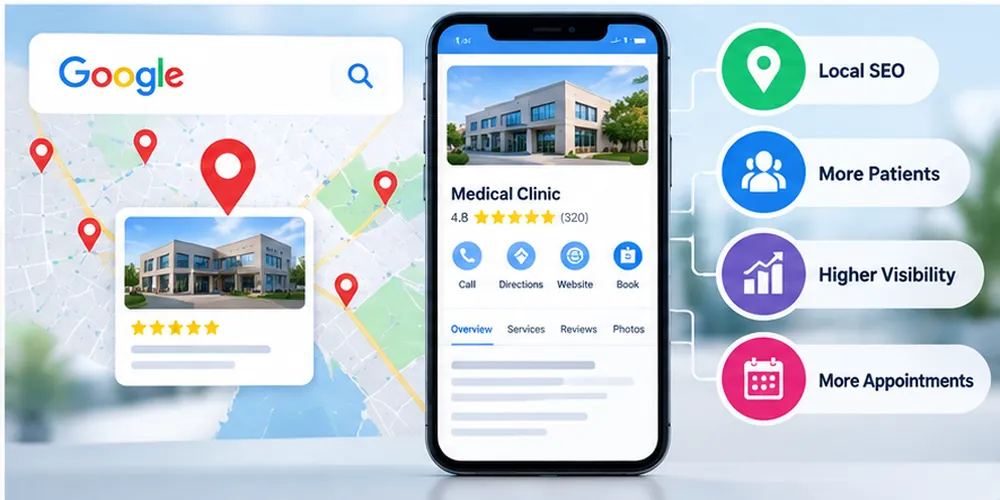
Each eligible Google Business Profile should contain:
- The real-world practice or physician name
- The most accurate primary category
- Relevant secondary categories
- Correct address and suite
- Current phone number
- Accurate public hours
- Matching location-page URL
- Correct appointment link
- Services genuinely available at that office
- Current facility and team photos
Website and profile information should agree. Old phone numbers, mismatched office hours and physicians listed at the wrong clinic can produce poor patient experiences.
The guide to local SEO for small businesses explains the wider relationship between profiles, Maps visibility, reviews, location pages and local trust.
The Google Business Profile of a Medical SEO Expert in Pakistan provides a direct view of the business identity, reviews and local contact presence connected with Waseem Marketing Expert.
Manage medical reviews carefully
Practices can request honest reviews without incentives or review gating. Responses should remain general and should not publicly confirm whether someone is a patient.
When a review requires case-specific follow-up, the public response can direct the reviewer to an approved private contact route.
Use On-Page SEO Without Keyword Stuffing
Every page needs one primary purpose. The main keyword should appear where it helps clarify that purpose, including the title, H1, introduction and relevant headings.
A strong medical page commonly includes:
- Unique SEO title
- One descriptive H1
- Direct opening answer
- Clean URL
- Logical H2 and H3 structure
- Natural medical terminology
- Service, physician and location relationships
- Descriptive internal links
- Original or approved images
- Accurate image alt text
- Useful FAQs
- Clear contact action
- Unique meta description
Semantic SEO expands the topic through meaning rather than keyword repetition. A page about local medical SEO may naturally include Google Business Profile, physician visibility, treatment pages, clinic locations, reviews, appointment requests, schema and local rankings.
Repeating the exact focus keyword in every paragraph makes the page less useful.
Fix Technical Problems That Block Medical Visibility
Strong content cannot rank consistently when search engines cannot crawl, render or index it correctly.
Technical checks should cover:
- Priority pages returning successful status codes
- Correct index and follow directives
- Self-referencing canonical tags
- XML sitemaps containing preferred URLs only
- Robots rules allowing important content and assets
- No broken internal links
- No unnecessary redirect chains
- Mobile-friendly menus and buttons
- Fast, stable page loading
- HTTPS across the website
- Correct titles and H1 headings
- Working contact and appointment forms
- Clear form-confirmation messages
- Controlled tag, archive and search-result pages
The medical practice SEO audit provides a 30-check framework covering technical access, medical trust, local visibility, conversion paths and patient-lead attribution.
Structured data can clarify visible information about the organization, physician, clinic location, article, service and breadcrumbs. Markup should match what visitors can see and should not contain unsupported information.
Prepare Content for AEO, GEO and AI Search
Answer Engine Optimization and Generative Engine Optimization do not replace traditional SEO. They improve how clearly a page communicates its subject, entities and direct answers.
Healthcare pages can become easier to interpret by using:
- A concise answer below question-based headings
- Consistent physician, practice and location names
- Clear relationships between conditions and services
- Tables for comparisons and requirements
- Numbered steps for processes
- Named authors and medical reviewers
- Descriptive headings
- Factual statements with enough context
- Original operational details
- Strong internal links
- Visible update dates
AI systems may break one broad question into several related searches. A person asking how to find a pain specialist may also need information about the condition, available treatment, physician credentials, insurance and location.
A well-connected topic cluster gives search and AI systems several useful passages while guiding visitors toward the correct page.
No website can guarantee inclusion in an AI-generated answer. Clear entities, accurate information, trustworthy authorship and accessible pages create a stronger foundation than artificial keyword repetition.
Convert Search Visits Into Appointment Opportunities

Healthcare SEO for medical practices produces limited value when visitors cannot complete the next step.
High-intent pages should provide:
- Visible phone number
- Click-to-call button on mobile
- Clear appointment-request action
- Treating physician information
- Correct clinic location
- Service availability
- New-patient guidance
- Insurance-verification information
- Short forms
- Response-time expectations
- Confirmation explaining what happens next
The action should match the visitor’s intent. Someone reading about symptoms may need a related condition or treatment page. A visitor on a local physician page may be ready to call. A branded visitor may only need directions or office hours.
Medical practices using organic and paid traffic can connect both channels through relevant landing pages. Google Ads services can capture immediate demand while organic healthcare content builds visibility over time.
Measure Qualified Patient Growth
SEO reporting should connect landing pages with patient outcomes without exposing sensitive information.
| Measurement stage | Useful metrics | Business question |
| Search visibility | Impressions, queries, rankings and local visibility | Can relevant patients find the practice? |
| Website engagement | Landing-page visits, call clicks and booking clicks | Does the page match the search? |
| Inquiry | Qualified phone calls and forms | Are suitable visitors contacting the practice? |
| Scheduling | Appointments booked by service and location | Are inquiries becoming scheduled visits? |
| Attendance | Attended new-patient appointments | Is SEO contributing to real patient growth? |
| Efficiency | Cost per qualified and attended patient | Is the investment commercially sustainable? |
Separate branded and non-branded performance. Branded searches may come from referrals, existing patients, advertising or offline awareness.
Reports should also separate educational traffic from treatment, physician and location traffic. A broad article can gain many visits while appointment volume remains unchanged.
Review Forms and Tracking for Privacy
Appointment forms, analytics, advertising pixels, chat tools and call-tracking platforms may receive sensitive information.
A responsible review should identify:
- Every form field
- Information transmitted through URLs
- Analytics events
- Advertising pixels
- Chat transcripts
- Call recordings
- Connected vendors
- Storage locations
- Access permissions
- Data-retention settings
General marketing forms should request only the information needed for the next step. Clinical records and detailed medical information should go through the practice’s approved secure systems.
Privacy, compliance and legal requirements vary by organization, technology and information collected. The practice should obtain appropriate guidance for its own systems.
Healthcare SEO by Practice Type
Different specialties require different keyword and page relationships.
Pain management clinics
Pain clinic websites often need condition, treatment, physician and location pages. Procedure availability should match the correct office and clinician.
Psychiatry and mental healthcare
Mental healthcare content needs clear distinctions between psychiatry, therapy, medication management and advanced treatments. Crisis information should remain separate from routine appointment promotion.
Ambulatory surgery centers
Surgery centers may need paths for patients, surgeons and referral offices. Procedure pages should explain the facility’s role without replacing a surgeon’s clinical evaluation.
Neurosurgery and spine practices
High-intent procedure searches require clear surgeon expertise, consultation locations and referral routes. Brain, spine and peripheral nerve topics should reflect the practice’s real clinical scope.
Dental practices
Dental SEO often combines service pages, dentist profiles, location visibility, reviews and emergency-intent searches.
Urgent care centers
Urgent care SEO needs accurate hours, walk-in information, services, insurance guidance and strong mobile contact options. Paid and organic targeting should avoid job-seeker queries.
Multi-location medical groups
Multi-location practices need consistent governance, unique location information, correct service availability and location-level lead reporting. One office should not claim physicians or services that belong to another location.
A 90-Day Healthcare SEO Plan
Days 1 to 30
- Confirm priority services, physicians and locations.
- Record current rankings, calls, forms and scheduled appointments.
- Audit indexing, canonicals, sitemaps and broken links.
- Build the keyword-to-URL map.
- Test phone numbers and forms.
- Verify clinic and physician information.
- Improve the highest-value service and location pages.
Days 31 to 60
- Build missing service and physician pages.
- Improve weak location content.
- Add named authors and reviewers where necessary.
- Connect conditions, treatments, physicians and locations.
- Correct local-profile categories, hours and appointment links.
- Improve mobile appointment actions.
- Add suitable structured data.
Days 61 to 90
- Publish supporting patient-question content.
- Review pages receiving impressions but few clicks.
- Review pages receiving traffic but few inquiries.
- Consolidate competing URLs.
- Compare lead quality by service and location.
- Validate form and call tracking.
- Plan the next quarter from performance evidence.
Publishing more articles should not replace corrections to service pages, local information or appointment routes.
Common Healthcare SEO Mistakes
Targeting traffic instead of patients
Broad educational keywords may bring visitors from outside the practice’s market. Balance informational content with high-intent services, physicians and locations.
Publishing several pages for one intent
Minor keyword variations do not always need separate URLs. Combine related wording when the visitor is making the same decision.
Copying location pages
Pages that only replace the city name provide little local value. Use genuine office information, physicians, available services, photos and contact details.
Publishing anonymous medical content
Medical articles should show who created or reviewed the information where clinical review is appropriate.
Listing unavailable services
Inaccurate treatment or location information wastes patient time and weakens trust.
Sending every local profile to the homepage
Each eligible profile should connect to the most relevant location page.
Using long appointment forms
Too many required fields can reduce completion rates and increase privacy risk.
Reporting traffic without appointments
Traffic is useful only when the practice can determine whether it contributes to suitable patient opportunities.
Promising rankings or patient outcomes
Search results depend on competition, website history, location, technical health, content quality and external authority. No provider controls a guaranteed position or patient total.
When Should a Medical Practice Hire an SEO Specialist?
Outside help may be valuable when a practice has:
- Several locations
- Numerous treatments or procedures
- Competing pages
- Weak local visibility
- Major indexing problems
- Inaccurate physician information
- Poor appointment conversion
- Limited lead attribution
- No medical review workflow
- Unclear AI search visibility
The provider should understand technical SEO, local profiles, healthcare content, physician authority, conversion paths and privacy boundaries.
Medical practices comparing strategic help can review the work of a healthcare SEO expert in Lahore with experience across pain management, mental healthcare, dental, surgery and related medical projects.The healthcare SEO portfolio provides examples of work involving local visibility, service-page structure, medical content and patient lead opportunities.
Healthcare SEO Checklist
- Define priority services and locations.
- Map one primary intent to every important URL.
- Create useful treatment, physician and location pages.
- Connect related medical entities through internal links.
- Add visible medical authorship and review.
- Verify physician credentials and affiliations.
- Keep website and local-profile information consistent.
- Improve local categories, services, photos and appointment links.
- Fix indexation, canonical and sitemap problems.
- Remove broken links and unnecessary redirects.
- Add structured data matching visible information.
- Write direct answers for AEO and GEO.
- Improve mobile calls and appointment actions.
- Use short forms with necessary fields only.
- Measure qualified calls and forms.
- Record scheduled and attended appointments.
- Review results by service, physician and location.
- Update pages when services or staff change.
Frequently Asked Questions
What is healthcare SEO for medical practices?
Healthcare SEO for medical practices improves service pages, physician profiles, location pages, local listings and technical website signals so suitable patients can find accurate information and request an appointment.
How is medical SEO different from regular SEO?
Medical SEO requires greater attention to clinical accuracy, authorship, physician credentials, service availability, patient privacy, local practice information and the journey from search to attended appointment.
Does every medical service need a separate page?
A separate page is useful when the service represents a distinct patient decision. Closely related services may belong on one stronger page when separate URLs would duplicate the same intent.
How long does healthcare SEO take?
Technical and local corrections may show early improvements within a few months. Competitive services can take longer. Timing depends on the market, website history, competition, content, technical condition and authority.
Can healthcare SEO help a practice appear in Google Maps?
Yes. Accurate Google Business Profiles, relevant categories, location pages, reviews, consistent information and local authority can strengthen Maps visibility. Distance still affects which results appear for each searcher.
Can medical content appear in AI-generated answers?
Clear, accurate and accessible content may become eligible for AI-assisted search results. Named authors, direct answers, entity consistency and strong internal relationships can improve clarity, but inclusion cannot be guaranteed.
Should a practice focus on blogs or service pages first?
Pages closest to patient decisions usually deserve priority. Strengthen core services, physicians, locations and appointment information before expanding the educational content cluster.
How should healthcare SEO ROI be measured?
Connect organic and local visibility to qualified calls, appointment requests, scheduled visits and attended patients. Review performance separately by landing page, service and location.
Can a medical practice use the same content for every location?
No. Each location page should provide real office information, physicians, available services, hours, photos, directions and appointment details. City-swapped copies can compete with one another.
Do medical practices need backlinks?
Relevant content, accurate local information, physician credibility and internal linking create the foundation. Competitive markets may also benefit from legitimate industry profiles, local citations, media mentions and earned links.
Final Takeaway
Healthcare SEO for medical practices works when every important patient decision has a clear destination. Conditions connect to relevant services, services connect to qualified physicians, physicians connect to genuine locations, and each high-intent page provides a simple appointment route.
Start with accurate services, providers and locations. Fix technical access. Strengthen medical trust. Build connected topic clusters. Improve local profiles. Create direct answers for traditional, voice and AI search. Then measure the full journey from visibility to attended appointments.
Medical practices that need a search plan based on their services, locations and patient-growth goals can contact Waseem Marketing Expert for a website and local visibility review.