A medical practice can buy clicks and still fail to gain suitable patients. The ad may target a broad phrase, send everyone to the homepage, attract job seekers or connect a high-intent search with a page that does not explain the physician, service, location or next step. Organic traffic can fail for similar reasons when blogs bring readers but treatment and location pages remain difficult to find.
A Google Ads for doctors SEO outline solves this disconnect by giving paid search and organic visibility one shared plan. It maps patient intent to campaigns, keywords, landing pages, service pages, physician profiles, locations, conversion actions and reporting. Google Ads supplies faster demand data. SEO uses that evidence to build useful search assets that can earn visibility over time.
The goal is not to make Google Ads improve organic rankings directly. It does not. The goal is to use both channels around the same patient journey so the practice can learn faster, reduce irrelevant traffic and measure progress from search to attended appointment.
A Google Ads for doctors SEO outline is a coordinated patient-acquisition plan connecting paid search campaigns with medical SEO, local search, landing pages and conversion measurement. It defines which specialties and locations deserve campaigns, which queries belong to advertisements or organic pages, how visitors should book, and how calls and forms become qualified, scheduled and attended patients.
The strongest outline contains ten connected parts:
- Practice growth priorities
- Patient-intent keyword research
- Campaign and ad-group structure
- Negative keyword controls
- Accurate advertising messages
- Service-specific landing pages
- Location targeting and Google Maps alignment
- Privacy-reviewed conversion tracking
- Paid and organic keyword feedback
- Appointment and patient-level reporting
Why Doctors Need a Combined Ads and SEO Plan
Google Ads and SEO solve different timing problems.
Google Ads can place a practice in paid results while a new treatment or location page has limited organic visibility. SEO builds service, physician, location and educational assets that may continue attracting relevant searches without paying for every website visit. Local SEO strengthens the practice information patients see in Google Maps and branded results.
Running these channels separately creates avoidable gaps:
- The Ads team bids on terms that have no suitable landing page.
- The SEO team writes articles around high-volume phrases that never create qualified inquiries.
- The practice cannot compare paid and organic calls by service.
- Location pages claim services that are unavailable at that office.
- Search-term data never reaches the content calendar.
- Organic query data never informs paid campaign testing.
- Staff count every call as a lead even when it is a job inquiry, wrong specialty or existing-patient request.
A coordinated plan gives each query a purpose, destination and measurement method.
| Channel | Main role | Fastest useful signal | Longer-term value |
| Google Ads | Capture active demand through paid placements | Search terms, clicks, calls and forms | Repeatable acquisition when economics work |
| Organic SEO | Earn visibility through relevant website pages | Impressions, clicks and landing-page engagement | Durable service and topic visibility |
| Local SEO | Connect services with real practice locations | Profile actions, local queries and map visibility | Stronger nearby discovery and trust |
| AEO and GEO | Make answers and entities easier to interpret | Question visibility and cited-page engagement | Broader presence across answer and AI search |
Doctors who need the wider organic foundation can review these SEO services alongside the paid-search plan.
Start With Services, Locations and Patient Eligibility
Campaign structure should follow the practice, not a generic keyword list. Begin by documenting what can actually be promoted.
For each service, record:
- Service or procedure name
- Treating physician
- Locations where it is available
- New-patient availability
- Referral requirements when applicable
- Insurance or payment information the practice can state accurately
- Age or intake restrictions that can be communicated appropriately
- Primary appointment route
- Commercial priority
- Staff capacity
This prevents a campaign from generating demand for an unavailable treatment or an office that cannot schedule the service.
Define A Qualified Patient Opportunity
A click is not a patient. A form submission is not automatically a qualified lead. The practice should agree on a practical reporting definition before launch.
A qualified opportunity may require:
- A new patient or permitted reactivation inquiry
- A requested service provided by the practice
- A location the person can reasonably attend
- Suitable payment or insurance circumstances
- A valid contact route
- No obvious job, vendor or unrelated intent
Clinical suitability remains a medical decision. Marketing qualification should not diagnose a person or promise that a treatment is appropriate.
Build One Shared Keyword and URL Map

The keyword map is the foundation of a Google Ads for doctors SEO outline. It prevents paid campaigns, service pages and blogs from targeting the same phrase without a defined role.
Use a sheet with these fields:
| Field | Purpose |
| Search theme | Groups related patient language |
| Query intent | Appointment, comparison, location, treatment or education |
| Specialty | Assigns the correct clinical service |
| Location | Connects demand with a real office |
| Ads campaign | Shows where paid targeting belongs |
| Ad group | Keeps closely related searches together |
| Landing page | Provides the best paid destination |
| Organic URL | Identifies the preferred ranking page |
| Conversion | Defines the next measurable action |
| Status | Existing, improve, build, test or exclude |
Map Keywords By Patient Intent
| Intent | Example search pattern | Paid-search role | Organic role |
| Immediate provider need | pain doctor near me | High-priority Search campaign | Specialty and location page |
| Procedure and location | spine surgeon Dallas | Procedure or specialty campaign | Physician, procedure and Dallas location pages |
| Appointment availability | psychiatrist accepting new patients | Test when the claim is accurate | Physician or location page |
| Treatment research | how does TMS work | Usually lower paid priority | Clinician-reviewed educational article |
| Cost or coverage | does insurance cover TMS | Test carefully by commercial value | Insurance or patient-information page |
| Branded | clinic name phone number | Brand campaign where justified | Homepage, contact and profile assets |
| Employment | medical assistant jobs | Exclude from patient campaigns | Careers page if the practice recruits |
The map should reflect intent rather than forcing every phrase into both channels.
Choose Keywords That Reflect Appointment Intent
Useful medical PPC keywords usually combine a provider, service, procedure or location with action-oriented language.
Examples include:
- pain management doctor near me
- psychiatrist in Richardson
- spine surgeon Dallas
- TMS therapy Plano
- urgent care open near me
- dentist accepting new patients
- neurosurgeon consultation
- ambulatory surgery center Dallas
Broad clinical terms can attract research, school assignments, careers, definitions and people outside the service area. A term is valuable only when the practice can serve the likely searcher and the landing page matches the decision.
Organize Keywords Into Intent Tiers
Tier one appointment intent
Provider, specialty, procedure and location searches usually deserve the first tests. These users are closer to selecting a practice.
Tier two comparison intent
Queries involving credentials, reviews, insurance or treatment comparisons can be valuable, but the page must answer the comparison clearly.
Tier three research intent
Symptom and definition searches often fit organic education better than paid acquisition. Test them only when evidence supports their value.
Excluded intent
Job searches, education, certification courses, salary queries, free downloads, unrelated specialties and services the practice does not offer should normally stay outside patient campaigns.
Create a Negative Keyword System
Negative keywords reduce irrelevant searches, but an overly broad list can block useful demand. Build the list from the practice model and update it using real search-term data.
Common Negative Keyword Categories
| Category | Examples to review | Important caution |
| Employment | jobs, hiring, salary, career, internship | Keep separate recruitment campaigns if needed |
| Education | school, degree, course, certification, training | Do not block patient education phrases automatically |
| Research | PDF, journal, definition, PowerPoint | Some research terms may assist treatment decisions |
| Wrong service | specialties and procedures not provided | Verify against the service list |
| Vendor intent | software, supplies, equipment wholesale | B2B practices may need some of these terms |
| Existing-patient tasks | portal, records, refill, bill pay | Branded campaigns may still require navigational routes |
| Geographic mismatch | distant cities or states | Use both exclusions and location settings |
Do not copy a generic healthcare negative list into every campaign. A psychiatry practice and a spine surgery practice have different false-positive risks. Review actual queries, lead quality and booking outcomes before expanding exclusions.
Structure Medical Google Ads by Commercial Decision
One campaign containing every physician, treatment and city makes budget control and reporting difficult. Group campaigns around decisions that deserve separate spending, geography or conversion goals.
Example Account Structure
Medical Practice Google Ads
├── Brand Search
├── Pain Management
│ ├── Pain Doctor
│ ├── Epidural Injection
│ └── Radiofrequency Ablation
├── Psychiatry
│ ├── Psychiatrist
│ ├── TMS Therapy
│ └── Medication Management
├── Spine and Neurosurgery
│ ├── Spine Surgeon
│ ├── Herniated Disc Surgery
│ └── Spinal Stenosis
└── Location Tests
├── Dallas
├── Richardson
├── Plano
└── Ennis
The names are examples, not a recommendation to advertise every service. Campaign eligibility, wording and landing pages must be reviewed for the actual specialty and market.
When To Separate Campaigns
Create a separate campaign when a service needs a distinct:
- Budget
- Geographic area
- Scheduling team
- Conversion goal
- Advertising policy review
- Landing-page group
- Business priority
- Operating schedule
Use tightly related ad groups within each campaign. An ad group should connect a coherent keyword theme with matching ad language and one suitable destination.
Medical practices seeking implementation can review Google Ads services for campaign research, setup, optimization and conversion measurement.
Write Accurate Ads Without Medical Overpromising
Healthcare advertising should be factual and specific. Unsupported superlatives, guaranteed results and absolute treatment claims can weaken trust and create policy or compliance risk.
Useful ad components include:
- Physician or clinic name
- Accurate specialty
- Real location
- Verifiable credential or experience detail
- New-patient availability when current
- Appointment action
- Insurance information only when confirmed
- Hours or same-day availability only when operationally accurate
Compare these approaches:
| Weak wording | Stronger factual direction |
| Best doctor guaranteed to fix your pain | Meet an interventional pain physician in Dallas |
| Cure depression fast | Request a psychiatric evaluation |
| Number one spine expert | View the surgeon’s credentials and procedures |
| Instant appointment available | Call to ask about current appointment availability |
Ad copy should also match the landing page. If an ad mentions a Richardson psychiatrist, the destination should not be a generic statewide homepage.
Review Healthcare Advertising Eligibility Before Launch
Healthcare advertising is not one unrestricted category. Rules may differ by service, country, certification status, landing-page content and targeting method. Prescription-drug services, telemedicine, pharmacies, addiction services and other regulated areas can require extra review or certification.
Health is also treated as a sensitive interest area for personalized advertising. A practice should not assume that every audience, remarketing or personalization method available to an ordinary retailer is available for a mental health, chronic-condition or medical-treatment campaign.
Before launch:
- Review the current Google Ads healthcare and medicines requirements.
- Review the rules for every country being targeted.
- Confirm whether certification is required.
- Check ad copy, keywords and landing pages together.
- Review audience eligibility for health-related campaigns.
- Obtain suitable legal and compliance guidance for the practice.
- Recheck policies when a service, location or platform rule changes.
This guide provides marketing information and is not legal, compliance or medical advice.
Build a Landing Page for Each Main Decision

Sending every medical ad to the homepage weakens message match. A focused landing page should continue the exact service and location promise made in the advertisement.
Doctor Landing-Page Framework
- Clear H1 stating the real service and location
- Short opening answer explaining what the practice offers
- Physician information with name, credentials and relevant profile link
- Who the service may help without diagnosing the reader
- Evaluation process explaining what happens before treatment decisions
- Location details including address, hours and directions context
- Insurance or payment guidance stated accurately
- Trust information such as verifiable credentials, facility details and genuine reviews
- Appointment action through a visible call or request button
- Privacy notice and responsible form design
- Mobile usability with readable copy and usable controls
- Confirmation step explaining what happens after submission
Use One Primary Action
Do not place five competing buttons above the fold. Choose the action most likely to move a qualified visitor forward, such as:
- Request an appointment
- Call the clinic
- Check current availability
- View the treating physician
The action can change by page. Urgent care may prioritize calls and directions, while an elective procedure page may use a consultation request.
Connect Google Ads With Local SEO and Google Maps
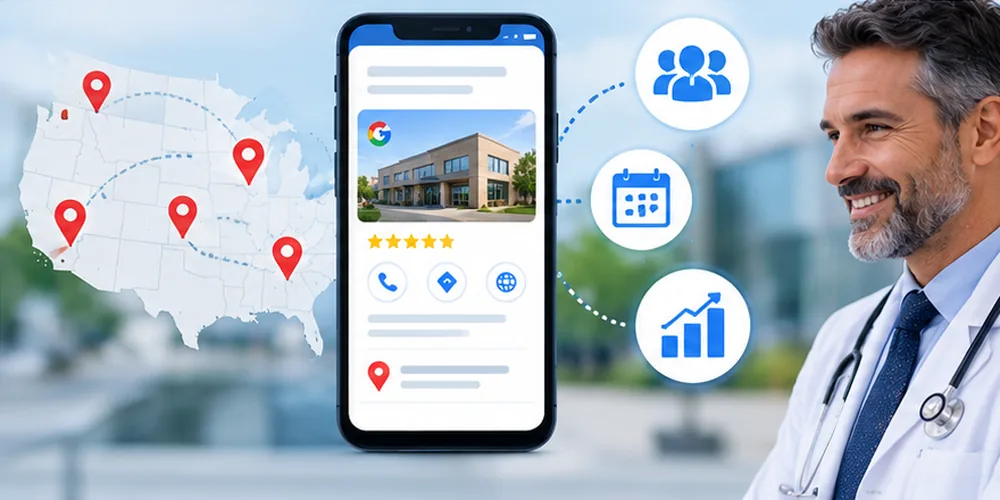
Patients often see paid results, organic pages, physician profiles, reviews and Google Maps during the same decision. The information across those surfaces should agree.
A local search alignment check should confirm:
- Practice name, address and phone number
- Hours and holiday hours
- Primary and secondary profile categories
- Physicians at each office
- Services available at each location
- Correct website and appointment URLs
- Current photographs
- Ethical review processes
- Privacy-aware review responses
The wider relationship between maps, websites and nearby searches is explained in this local SEO guide for small businesses.
Review Advanced Location Settings
Google Ads can use physical presence and location interest signals. A local clinic that only wants nearby patients should review whether its campaign needs a presence-focused setting rather than broader presence-or-interest reach. No location system is perfectly precise, so check actual user locations, search terms and lead quality after launch.
Use Location Assets Carefully
Connect eligible business locations so ads can display useful location information. Each linked profile should represent a genuine, staffed location with accurate details. Do not connect closed, duplicate or unrelated profiles.
Target Texas and Nearby Cities Without Keyword Stuffing
A Texas medical practice can target statewide language only when its service model supports that reach. Most local clinics should begin with cities and realistic travel areas around active locations.
| Market | Example paid theme | Best organic destination |
| Dallas | Google Ads for Dallas doctors, procedure plus Dallas | Service, physician and Dallas location pages |
| Richardson | local doctor advertising Richardson, specialty plus Richardson | Richardson clinic page linked to active physicians |
| Plano | medical PPC Plano, treatment plus Plano | Plano service and provider pages |
| Ennis | Google Ads for clinics in Ennis | Ennis location page with real services and hours |
| Fort Worth | specialist advertising Fort Worth | Verified Fort Worth location and treatment pages |
Do not place every city in one paragraph simply to create relevance. Mention a location where the practice has a real office, service area, physician, patient route or campaign plan.
Adapt the Framework by Medical Specialty
The same campaign template should not be copied across specialties. Patient intent, urgency, policies, page requirements and intake workflows differ.
Pain Management
Build around provider, condition, procedure and location intent. Keep research terms separate from appointment searches. Connect each procedure to the physician and offices where it is available.
Psychiatry And Mental Health
Use careful language, review sensitive-interest advertising limitations and avoid copy that implies knowledge of the searcher’s personal condition. Separate general psychiatry, medication management, TMS and other active services when each has a suitable page and budget.
Spine Surgery And Neurosurgery
Patients may compare conditions, procedures, credentials and hospital access before contacting a surgeon. Landing pages should connect procedure information with the surgeon’s verified background and the correct treatment location.
Dentistry
Separate emergency intent from elective and routine services. An emergency tooth query needs a faster call path than a cosmetic comparison query.
Urgent Care
Hours, location, current service availability and directions strongly influence the decision. Ads and pages must be updated when operating hours change.
Ambulatory Surgery Centers
Clarify the facility’s role, procedures, physician relationships and patient contact path. Do not imply that every visitor can schedule a procedure without the required clinical and administrative steps.
| Specialty | High-intent cluster | Useful page relationship |
| Pain management | pain doctor, procedure, city | Treatment → physician → location |
| Psychiatry | psychiatrist, evaluation, treatment, city | Service → psychiatrist → location |
| Spine surgery | surgeon, procedure, condition, city | Procedure → surgeon → facility |
| Dentistry | dentist, emergency, service, city | Service → dentist → office |
| Urgent care | urgent care, open now, city | Service → hours → directions |
| Surgery center | procedure, center, city | Procedure → physician → facility |
Build Privacy-Aware Conversion Tracking
Conversion tracking helps the practice understand whether advertising produces useful actions, but healthcare data needs careful handling. Tracking technology, form fields, call systems and connected vendors should be reviewed according to the practice’s legal and privacy obligations.
Separate Primary And Secondary Conversions
Primary conversions may include:
- Qualified phone calls
- Completed appointment requests
- Confirmed online bookings
- Qualified lead status imported from an approved system
Secondary observations may include:
- Phone-number clicks
- Directions clicks
- Appointment-button clicks
- Form starts
- Engaged landing-page visits
Do not optimize automated bidding toward low-value actions simply because they are easy to count.
Minimize Submitted Information
An advertising form should request only the details needed for initial contact. Avoid sending symptoms, diagnoses, medications, free-text medical histories or other sensitive information into advertising platforms without an approved compliance design.
Use Privacy-Reviewed Status Labels
Where permitted, the practice may use operational stages such as:
- New inquiry
- Qualified inquiry
- Appointment requested
- Appointment scheduled
- Appointment attended
- Not eligible
- Existing patient
- Job seeker
- Wrong service
The advertising platform does not need clinical details to distinguish a booked appointment from an irrelevant lead. The exact implementation should be reviewed by the practice and its qualified privacy advisers.
Track the Full Search-to-Patient Funnel
A campaign can look successful when it produces cheap forms that never become appointments. Reporting should connect marketing activity with front-desk outcomes.
| Funnel stage | Paid metrics | Organic and local metrics | Business outcome |
| Visibility | Impressions, impression share | Search impressions, local visibility | Practice appears for relevant demand |
| Engagement | Clicks, click-through rate | Organic visits, profile actions | Searcher reaches a suitable page |
| Inquiry | Calls, forms, booking requests | Organic calls and forms | Potential patient contacts the practice |
| Qualification | Qualified lead rate | Qualified organic inquiry rate | Inquiry matches service and location |
| Scheduling | Cost per scheduled appointment | Scheduled appointments from organic | Staff converts inquiry into appointment |
| Attendance | Cost per attended patient | Attended patients from organic | Marketing contributes to patient growth |
Useful Calculations
Landing-page conversion rate
Conversions ÷ landing-page visits × 100
Qualified lead rate
Qualified inquiries ÷ total inquiries × 100
Scheduling rate
Scheduled appointments ÷ qualified inquiries × 100
Attendance rate
Attended appointments ÷ scheduled appointments × 100
Cost per attended patient
Advertising spend ÷ attended patients attributed through an approved method
Use consistent definitions across locations and months. A reporting change can look like performance growth when the underlying lead volume did not change.
Plan the Budget Around Capacity and Economics
There is no universal medical Google Ads budget. Cost varies by specialty, treatment value, competition, geography, schedule, landing page, lead quality and conversion rate.
Use practice data instead of copying a national benchmark.
Budget Planning Sequence
- Select one or two commercially important services.
- Confirm appointment capacity for those services.
- Estimate local click ranges using current advertising data.
- Review historical website and call conversion rates when available.
- Define an acceptable cost per qualified inquiry.
- Define an acceptable cost per scheduled and attended patient.
- Allocate enough testing budget to produce decision-quality data.
- Protect the test from unrelated campaigns competing for the same budget.
- Expand only after lead quality and scheduling outcomes are understood.
Capacity Matters
If one office cannot accept new patients for six weeks, sending more paid traffic may create frustration rather than growth. Shift spend only when another suitable physician, service or location can receive the demand accurately.
Turn Paid Search Data Into SEO Priorities
This feedback loop is the most valuable part of a Google Ads for doctors SEO outline.
Step One Collect Real Search Terms
Review the phrases that actually triggered advertisements. Keywords are targeting inputs. Search terms reveal how users expressed their need.
Step Two Connect Queries With Lead Quality
Identify which themes generated qualified calls, appointment requests and scheduled visits. Do not judge a keyword only by click-through rate.
Step Three Compare The Organic Destination
Check whether the website already has a strong service, physician or location page for the converting theme.
Step Four Assign The Right Seo Asset
Create or improve the appropriate page:
- Service page for treatment intent
- Physician profile for provider intent
- Location page for nearby clinic intent
- Patient-information page for insurance or appointment questions
- Article for research-stage questions
Step Five Build Internal Relationships
Connect the service with the treating physician, location and relevant patient information. This helps users and search systems understand the practice structure.
Step Six Measure Both Channels Separately
Track paid and organic performance without claiming that advertising caused an organic ranking change. Compare trends, query coverage and patient outcomes.
Step Seven Adjust Spending Carefully
An organic ranking does not automatically mean paid advertising should stop. The paid listing may still add incremental appointments, protect a valuable query or provide controlled testing. Review total search visibility and patient economics before changing spend.
Use Organic Data to Improve Google Ads
The feedback also works in reverse.
Organic data can reveal:
- Service pages already attracting local demand
- High-impression queries that rank below the strongest positions
- Cities showing unexpected search interest
- Patient questions suitable for landing-page FAQs
- Pages with strong engagement but weak appointment actions
- Branded searches that may or may not need paid protection
Test promising commercial themes in a controlled campaign. Keep informational traffic in organic content unless the practice has a clear paid objective and conversion route.
Build Topic Clusters Without Creating Cannibalization
Topical authority does not mean publishing dozens of pages using the same primary keyword. A useful doctor marketing cluster assigns a separate intent to every URL.
Core Commercial Pages
- Google Ads services
- SEO services
- Healthcare marketing or doctor SEO service page
- Specialty service pages
- Location pages
Supporting Articles
- Google Ads for doctors SEO outline
- Healthcare SEO vs Google Ads
- Medical practice SEO audit
- Medical SEO cost
- Healthcare website conversion optimization
- HIPAA-aware website forms
- Healthcare lead tracking
- Multi-location healthcare SEO
- Local SEO for specialty clinics
Cannibalization Rules
- Give every URL one main search intent.
- Keep the comparison blog focused on choosing between channels.
- Keep this guide focused on the combined implementation framework.
- Keep the Google Ads service page focused on hiring and deliverables.
- Keep doctor SEO service pages focused on organic and local services.
- Link related pages with descriptive anchors.
- Consolidate pages that answer the same decision with little unique value.
A healthcare marketing expert in Pakistan can map paid and organic pages around specialties, locations and lead goals when a practice has several competing URLs.
Prepare Doctor Content for AEO GEO and AI Search
Paid advertisements do not buy inclusion in organic AI answers. AI and answer visibility depend on the accessible website content and the search systems evaluating it.
Use the SEO side of the plan to publish:
- Direct definitions beneath question headings
- Named physician and reviewer information where clinically relevant
- Clear relationships between services, physicians and locations
- Concise appointment and evaluation steps
- Useful comparison tables
- Accurate business information
- Original observations from real campaign and practice workflows
- Descriptive page titles, headings and internal links
- Structured data matching visible content
- Updated review dates where freshness matters
Avoid thin city pages and mass-produced answers. A page should help a patient make progress even if it never appears in an AI result.Businesses that want help aligning Google Maps, website pages and local search visibility can consult a Medical SEO Expert in Pakistan.
Strengthen E-E-A-T Across Ads and Organic Pages
The advertisement, landing page and organic page should make the practice easy to verify.
Relevant trust elements include:
- Full physician names and credentials
- Accurate education and training information
- Board certification details where applicable
- Real clinic locations and contact information
- Services genuinely provided
- Named medical reviewers for clinical content
- Publication and review dates
- Clear privacy and editorial information
- Original practice photography
- Genuine reviews presented responsibly
- Claims that can be substantiated
Do not add badges, certifications, affiliations or treatment outcomes that the practice cannot verify.Waseem Marketing Expert’s healthcare and SEO portfolio shows work involving pain management, psychiatry, dental, medical billing and other service-driven campaigns.
A 90-Day Google Ads and SEO Implementation Plan
Days 1 To 30
- Confirm priority services, physicians and locations.
- Define qualified, scheduled and attended-patient stages.
- Audit current Google Ads, website pages, local profiles and tracking.
- Build the shared keyword and URL map.
- Review advertising eligibility and privacy requirements.
- Correct the highest-priority landing page.
- Create initial negative keyword categories.
- Record a baseline for paid, organic and appointment outcomes.
Days 31 To 60
- Launch controlled Search campaigns for selected services.
- Separate campaigns where budgets or locations need independent control.
- Add accurate call and location assets where eligible.
- Review search terms and lead quality regularly.
- Improve service, physician and location pages using early demand evidence.
- Connect related pages with internal links.
- Train intake staff to record source and lead status consistently.
Days 61 To 90
- Compare cost per inquiry, qualified lead, scheduled appointment and attended patient.
- Identify paid search terms that deserve organic pages or page improvements.
- Identify organic queries worth testing in Ads.
- Improve weak landing-page conversion paths.
- Expand negatives without blocking valuable patient intent.
- Shift budget toward services with capacity and verified outcomes.
- Document the next quarter by specialty and location.
Common Google Ads Mistakes Medical Practices Make
Sending Every Click To The Homepage
The homepage cannot match every specialty, treatment and location. Use focused destinations.
Combining All Services In One Campaign
This hides budget and lead-quality differences between specialties.
Targeting Symptoms Without A Commercial Plan
Broad symptom traffic may create research visits rather than appointments.
Ignoring Negative Keywords
Job seekers, students, vendors and unrelated services can consume the budget.
Counting Every Form As A Success
Report qualified inquiries, scheduled appointments and attended visits.
Using The Wrong Location Option
Clicks from outside the practical service area can appear when location settings and exclusions are not reviewed.
Making Unsupported Medical Claims
Absolute outcomes and unverifiable superlatives create trust and policy risk.
Tracking Sensitive Information Without Review
Forms, call tools, pixels and connected vendors require privacy and compliance evaluation.
Treating Ads As An Organic Ranking Factor
Paid spend does not directly raise organic positions. Use campaign evidence to make better SEO decisions.
Publishing Duplicate City Pages
Location pages need real physicians, services, hours, contact routes and office information.
Google Ads for Doctors Checklist
- Confirm the services and locations that can accept new patients.
- Define qualified, scheduled and attended stages.
- Map keywords to campaigns and preferred organic URLs.
- Separate major specialties and budgets where needed.
- Build negative keywords from actual irrelevant intent.
- Match each ad group with a suitable landing page.
- Use factual ad language without outcome guarantees.
- Review current healthcare advertising policies.
- Review sensitive-interest audience limitations.
- Check location targeting and exclusions.
- Connect accurate location and call assets where eligible.
- Make mobile calls and booking actions easy.
- Minimize form fields and review data handling.
- Keep primary and secondary conversions separate.
- Connect search terms with lead quality.
- Turn proven demand into service, physician and location pages.
- Use internal links to connect the clinical entity structure.
- Measure cost per scheduled and attended patient.
- Review results by specialty and location.
- Update the plan when capacity or services change.
Frequently Asked Questions
What Is A Google Ads For Doctors Seo Outline?
A Google Ads for doctors SEO outline is a shared plan for paid search, organic SEO, local visibility, landing pages and patient-lead measurement. It maps each important search intent to a campaign, website page, location and next action.
Do Google Ads Improve Seo Rankings For Doctors?
No. Paying for Google Ads does not directly improve organic rankings. Ads can provide search-term, location and conversion evidence that helps a practice choose better SEO priorities.
Should A New Medical Practice Start With Google Ads Or Seo?
The answer depends on demand, website condition, budget and appointment capacity. Ads can test immediate demand, while SEO builds longer-term service and location visibility. Many practices use a controlled paid campaign while strengthening the organic foundation.
Which Google Ads Campaign Type Is Best For Doctors?
Search campaigns are often a practical starting point because they can reach people actively searching for a provider or service. The final campaign mix should reflect the specialty, advertising eligibility, creative assets, market and conversion data.
What Keywords Should Doctors Target In Google Ads?
Prioritize provider, specialty, procedure and location searches that match real services. Examples include psychiatrist in Richardson, pain doctor near me or spine surgeon Dallas. Review actual search terms and lead quality before expanding.
What Negative Keywords Should A Medical Practice Use?
Common categories include jobs, salaries, courses, schools, unrelated specialties, distant locations and services not provided. Build the list for the specific practice rather than copying a universal template.
Should Medical Ads Link To The Homepage?
Usually, a focused service and location landing page provides a clearer match. The homepage may suit brand searches, but it rarely answers every treatment or specialty query well.
How Should Doctors Track Google Ads Leads?
Track calls, forms and booking requests, then connect them with qualified, scheduled and attended stages through an approved process. Avoid sending unnecessary medical information into advertising platforms.
Can Psychiatrists Use Remarketing Campaigns?
Health and mental health content can fall within sensitive-interest advertising restrictions. Eligibility depends on the campaign, audience, service, location and current policies. Review the exact planned setup before launch.
How Much Should A Doctor Spend On Google Ads?
There is no universal figure. Base the budget on local click costs, specialty competition, landing-page performance, appointment capacity and an acceptable cost per qualified and attended patient.
How Can Google Ads Data Help Medical Seo?
Search-term and conversion data can reveal which services, questions and locations generate qualified demand. The SEO team can then improve the most relevant treatment, physician, location and patient-information pages.
Can One Campaign Target Dallas Richardson Plano And Ennis?
It can, but separate campaigns may be better when locations have different budgets, physicians, services, hours or lead quality. At minimum, use accurate local pages and review results by location.
How Long Should A Google Ads And Seo Test Run?
The practice needs enough time and volume to evaluate lead quality, scheduling and attendance. Avoid judging the campaign from a few clicks, but do not let clearly irrelevant traffic continue while waiting for more data.
Final Takeaway
A Google Ads for doctors SEO outline works when paid and organic search share the same patient-acquisition logic. The practice identifies the services and locations it wants to grow, maps appointment intent to focused campaigns and pages, controls irrelevant traffic, measures qualified leads and turns proven demand into stronger organic assets.
Start with a small number of high-priority services. Build accurate landing pages. Review healthcare advertising and privacy requirements. Connect Ads with local profiles, physician pages and location pages. Then judge performance through scheduled and attended patients rather than clicks alone.
Medical practices that need a coordinated campaign and search-visibility plan can book a free consultation to review their services, locations, current advertising and patient-lead process.