Entrepreneurial skills are the practical abilities that help a person start, manage, improve, and grow a business. These skills include communication, sales, marketing, financial literacy, decision-making, leadership, problem-solving, digital literacy, time management, and the ability to adapt when plans change.
A business owner does not grow only because they have a good idea. Growth happens when that idea is explained clearly, priced correctly, promoted to the right people, tested in the market, improved with feedback, and supported by smart decisions. That is where entrepreneurial skills matter. They help you turn daily business pressure into clear action, whether you are trying to get more leads, build trust, manage cash flow, improve your website, hire help, or compete in a busy market.
Many entrepreneurs start with passion, but passion alone cannot manage budgets, answer customer questions, build a sales system, improve Google rankings, or decide which marketing channel deserves more attention. The stronger your entrepreneur skill set becomes, the easier it is to make better choices and avoid random guessing.
Why Entrepreneurial Skills Matter for Business Owners
Entrepreneurial skills matter because every business owner faces problems that need more than motivation. You may need to handle slow sales, rising ad costs, low website traffic, unhappy customers, weak cash flow, team mistakes, or strong competition.
The right skills help you:
- Make better business decisions
- Understand your customers more clearly
- Build trust through communication
- Manage money with less confusion
- Sell your offer with confidence
- Improve your marketing strategy
- Track results instead of guessing
- Solve problems faster
- Use time wisely
- Build systems that support growth
For small business owners, these skills are not just personal qualities. They affect leads, sales, customer retention, online visibility, brand trust, and long-term stability.
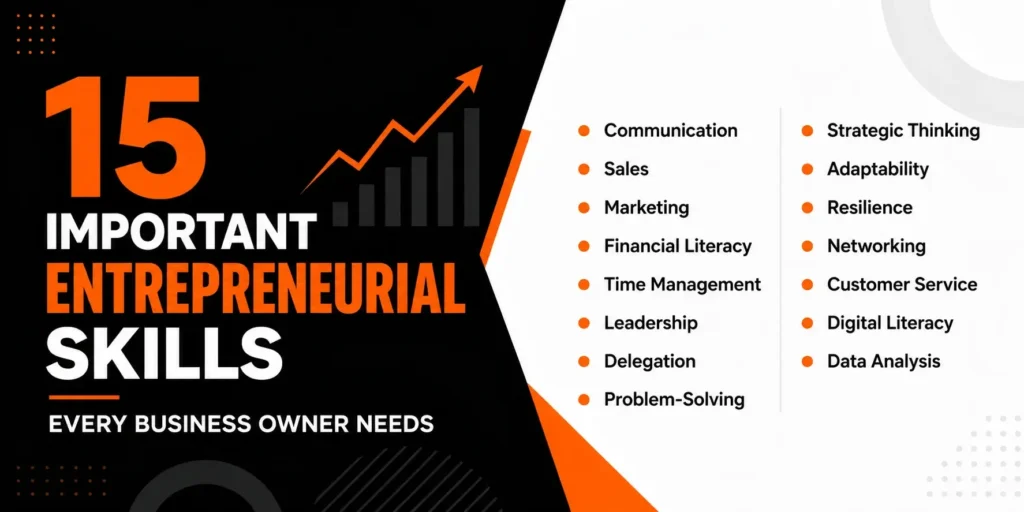
15 Important Entrepreneurial Skills Every Business Owner Needs
1. Communication Skills
Communication is one of the most important entrepreneurial skills because every business depends on clear messages. You need it when speaking with customers, writing website copy, explaining your services, managing a team, negotiating with vendors, and creating marketing content.
Good communication helps customers understand:
- What you offer
- Who you help
- Why your service matters
- What problem do you solve
- What action should they take next
For online business growth, communication also affects landing pages, service pages, social media captions, email replies, sales calls, Google Ads copy, and blog content. If your message is unclear, even strong traffic may not turn into leads.
Example:
A dentist, contractor, coach, lawyer, consultant, or local service provider can lose leads if their website confusingly explains services. Clear wording can improve trust before the first phone call.
2. Sales Skills
Sales skills help entrepreneurs turn interest into action. Selling is not only about convincing people. It is about understanding needs, answering doubts, explaining value, and guiding the right customer toward a clear decision.
A business owner with strong sales skills can:
- Ask better questions
- Understand customer pain points
- Explain pricing with confidence
- Handle objections
- Follow up without sounding pushy
- Close deals based on value, not pressure
Sales is also linked with digital marketing. Your website, ads, emails, and social media pages are part of your sales process. If your offer is weak or your call to action is unclear, your marketing may bring traffic but not enough customers.
3. Marketing Skills
Marketing skills help entrepreneurs reach the right audience. A good product can stay invisible if people do not know it exists. Marketing allows business owners to build awareness, attract leads, and stay present in the minds of potential customers.
Important marketing skills include:
- Understanding the target audience
- Creating a clear offer
- Writing useful content
- Choosing the right channels
- Building trust through proof
- Tracking campaign results
- Improving based on data
For modern entrepreneurs, marketing skills often include SEO, local SEO, Google Ads, social media marketing, email marketing, content writing, and lead generation. You do not need to master every platform yourself, but you should understand how each channel supports business growth.
4. Financial Literacy
Financial literacy means understanding the numbers behind your business. This includes revenue, expenses, profit, cash flow, pricing, taxes, budgets, and return on investment.
A business owner with financial literacy can answer questions like:
- Are we making a profit or only getting sales?
- Which service brings the best margin?
- How much can we spend on ads?
- Is the pricing too low?
- Which cost should be reduced?
- When is it safe to hire help?
Financial literacy also improves marketing decisions. For example, if you spend money on Google Ads or SEO, you need to understand cost per lead, conversion rate, customer value, and profit margin. Without basic numbers, marketing becomes guesswork.
5. Time Management
Entrepreneurs often handle too many tasks at once. Time management helps you focus on the work that moves the business forward instead of staying busy with low-value tasks.
Strong time management includes:
- Setting priorities
- Planning the day
- Avoiding distractions
- Creating deadlines
- Limiting unnecessary meetings
- Tracking important tasks
- Knowing what to delegate
A business owner should not spend all day fixing small issues while ignoring sales, service quality, customer follow-up, website improvement, or financial planning. Time is limited, so it must be used with intention.
6. Leadership Skills
Leadership skills help entrepreneurs guide people, make decisions, and create direction. Even if you are a solo business owner, leadership still matters because you must lead yourself, your brand, your partners, your freelancers, and your customer experience.
Good leadership includes:
- Clear decision-making
- Accountability
- Confidence
- Honesty
- Patience
- Team direction
- Problem ownership
- Long-term thinking
Leadership is not about controlling every detail. It is about helping people understand what matters and why it matters.
7. Delegation Skills
Delegation means giving the right task to the right person at the right time. Many entrepreneurs struggle with this because they think nobody else can do the work properly. But without delegation, growth becomes harder.
You may need to delegate:
- Website updates
- SEO tasks
- Content writing
- Social media posting
- Admin work
- Bookkeeping
- Customer support
- Design work
- Ad campaign management
Delegation does not mean losing control. It means creating space for higher-value decisions. When you delegate routine tasks, you can focus more on sales, strategy, partnerships, customer experience, and growth.
8. Problem-Solving Skills
Every business faces problems. Customers complain, campaigns fail, websites break, employees leave, costs rise, and competitors improve. Problem-solving helps entrepreneurs stay calm and find the next best move.
Good problem-solving includes:
- Finding the real cause
- Studying the situation
- Comparing options
- Taking action quickly
- Testing the result
- Learning from mistakes
For example, if a website gets traffic but no leads, the problem may not be SEO. It could be a weak copy, a poor offer, a slow speed, missing trust signals, bad form placement, or an unclear call to action. A skilled entrepreneur looks beyond the surface.
9. Strategic Thinking
Strategic thinking helps business owners make decisions based on direction, not emotion. It connects daily work with long-term goals.
A strategic entrepreneur asks:
- Who is our best customer?
- What problem do we solve better than others?
- Which service should we grow first?
- Which marketing channel gives better leads?
- What should we stop doing?
- Where do we want the business to be in 12 months?
Without strategic thinking, a business can waste time on random trends. With strategy, every action has a reason.
10. Adaptability
Adaptability is the ability to adjust when the market changes. Customer behavior, Google updates, ad costs, technology, local competition, and buying habits can shift quickly.
Adaptable entrepreneurs do not panic when something changes. They review the facts, update the plan, and keep moving.
Examples of adaptability include:
- Changing your offer based on customer demand
- Updating website content after search behavior changes
- Testing a new marketing channel
- Improving pricing when costs increase
- Using AI tools wisely
- Training your team on new systems
Adaptability does not mean changing direction every week. It means staying flexible while keeping your main goal clear.
11. Resilience
Resilience helps entrepreneurs keep going during pressure, delay, rejection, or failure. Business growth is rarely smooth. Some months are strong. Some campaigns fail. Some customers say no. Some ideas do not work.
Resilience helps you continue without ignoring reality. It allows you to learn, adjust, and try again with a better plan.
A resilient entrepreneur:
- Accepts feedback
- Learns from failure
- Handles stress with maturity
- Avoids emotional decisions
- Keeps improving skills
- Does not quit after one setback
Resilience is not blind positivity. It is the ability to face problems and still make useful decisions.
12. Networking Skills
Networking helps entrepreneurs build relationships that can lead to referrals, partnerships, advice, visibility, and new business opportunities.Good networking is not just about collecting contacts. It is about building real professional trust.
You can build networking skills by:
- Joining business groups
- Attending local events
- Speaking with other founders
- Staying active on LinkedIn
- Helping others before asking for help
- Building referral relationships
- Following up after conversations
For service-based businesses, networking can become a strong lead source when combined with a clear website and strong online presence.
13. Customer Service Skills
Customer service is a business growth skill. Happy customers return, refer others, leave reviews, and trust your brand. Poor service can damage your reputation even if your marketing is strong.
Customer service skills include:
- Listening carefully
- Responding quickly
- Solving issues
- Setting clear expectations
- Following up
- Staying polite under pressure
- Improving based on feedback
Online reviews, social proof, testimonials, and repeat sales often depend on customer service. A business that treats customers well has a stronger chance of long-term growth.
14. Digital Literacy
Digital literacy is now one of the most important entrepreneurship skills. Business owners need to understand how online tools, websites, search engines, ads, analytics, and content platforms affect growth.
Digital literacy includes knowing the basics of:
- SEO
- Google Business Profile
- Google Ads
- Social media platforms
- Website structure
- Landing pages
- Email marketing
- CRM systems
- Analytics tools
- Online reviews
- AI tools
You do not need to become a technical expert in every area. But you should know enough to ask better questions, choose better partners, and understand what is happening in your business.
15. Data Analysis
Data analysis helps entrepreneurs make decisions based on real numbers. It shows what is working, what needs improvement, and where money or time may be wasted.
Useful business data includes:
- Website traffic
- Keyword rankings
- Leads
- Calls
- Form submissions
- Sales
- Cost per lead
- Conversion rate
- Customer lifetime value
- Repeat purchases
- Review growth
For example, if SEO traffic increases but leads stay low, the website may need better service pages, clearer offers, stronger calls to action, or improved trust signals. Data helps you find the weak point.
Entrepreneurial Skills Examples in Real Business
| Entrepreneurial Skill | Business Example | Online Growth Example |
| Communication | Explaining your service clearly | Writing better landing page copy |
| Sales | Turning inquiries into customers | Improving call scripts and follow-ups |
| Marketing | Reaching the right audience | Using SEO, Google Ads, and content |
| Financial literacy | Managing profit and expenses | Setting ad budgets based on ROI |
| Time management | Prioritizing important work | Planning content and campaigns |
| Leadership | Guiding a small team | Managing freelancers and vendors |
| Delegation | Assigning routine tasks | Hiring help for SEO, ads, or content |
| Problem-solving | Fixing customer issues | Improving low-converting pages |
| Strategic thinking | Choosing the best growth path | Building a keyword and content plan |
| Adaptability | Adjusting to market changes | Updating content after Google changes |
| Resilience | Staying steady under pressure | Improving campaigns after poor results |
| Networking | Building referral partners | Growing LinkedIn and brand mentions |
| Customer service | Keeping customers satisfied | Getting more positive reviews |
| Digital literacy | Understanding online tools | Reading SEO, ad, and analytics reports |
| Data analysis | Tracking business results | Measuring traffic, leads, and sales |
Entrepreneurial Skills for Small Business Owners
Small business owners need practical skills that help them manage limited time, limited budget, and high responsibility. Unlike large companies, small businesses often depend on one person or a small team to handle sales, marketing, operations, service delivery, and customer communication.
The most useful small business skills include:
- Clear communication
- Local marketing
- Cash flow management
- Customer service
- Lead generation
- Time management
- Pricing decisions
- Website understanding
- Online reputation management
- Basic reporting
For a small business, even one weak area can affect growth. A poor website can reduce trust. Weak follow-up can lose leads. Bad pricing can damage profit. Low review quality can reduce calls. This is why entrepreneurial skills should be developed as part of daily business work, not treated as theory.
Entrepreneurial Skills for Online Business Growth
Today, entrepreneurs need more than offline business skills. Customers search online before making decisions. They compare websites, read reviews, check social media, look at Google results, and judge trust before contacting a business.

For online growth, entrepreneurs should understand these skills:
SEO Understanding
SEO helps your business appear when people search for your services. Entrepreneurs should understand keyword research, search intent, page quality, local SEO, internal linking, and helpful content.
Content Writing
Content helps explain your services, answer customer questions, and build trust. Strong content can support rankings, leads, sales calls, and brand authority.
Lead Generation
Lead generation means turning attention into inquiries. This can happen through SEO, Google Ads, landing pages, forms, WhatsApp clicks, phone calls, email campaigns, and social media.
Website Conversion
A website should not only look good. It should help visitors understand your offer and take action. Clear headings, trust signals, calls to action, fast loading, mobile usability, and simple forms can improve results.
Paid Ads Knowledge
Google Ads and social ads can bring faster visibility, but only when targeting, keywords, ad copy, landing pages, and tracking are set up properly. Entrepreneurs should understand the basics before spending money.
Analytics and Reporting
Reports help you see which actions bring results. Tracking leads, calls, keyword rankings, traffic, and conversions makes growth easier to manage.
How to Develop Entrepreneurial Skills

Entrepreneurial skills can be learned through practice, feedback, study, and real business experience. You do not need to become perfect in every area at once. Start with the skill that affects your current business problem the most.
1. Identify Your Weakest Business Area
Ask yourself:
- Am I struggling to get leads?
- Am I getting leads but not closing sales?
- Is my cash flow unclear?
- Am I spending too much time on small tasks?
- Is my website failing to convert visitors?
- Do customers understand my offer?
- Am I tracking the right numbers?
2. Learn One Skill at a Time
Trying to improve everything at once can create confusion. Choose one skill and study it for 30 days. For example, you can focus on sales follow-up, SEO basics, financial tracking, time planning, or customer service.
3. Use Real Business Tasks as Practice
The best way to build entrepreneurial skills is through action. Instead of only reading, apply the skill in your business.
Examples:
- Rewrite your homepage message
- Track weekly leads
- Improve your service page
- Test a new call script
- Review your monthly expenses
- Create a content calendar
- Ask customers for feedback
- Update your Google Business Profile
4. Get Feedback
Feedback helps you see what you may miss. Ask customers, team members, mentors, consultants, or trusted business contacts for honest input.
Useful questions include:
- Is my offer clear?
- What stopped you from buying?
- What made you trust us?
- What should we improve?
- Was the website easy to use?
- Did the service meet your expectations?
5. Track Progress With Simple Metrics
You cannot improve what you do not measure. Start with simple numbers:
- Leads per month
- Calls per month
- Website traffic
- Form submissions
- Sales conversion rate
- Average order value
- Repeat customers
- Review count
- Revenue
- Profit margin
Entrepreneurial Skills Checklist
Use this checklist to review your current skill level.
Communication
- Can you explain your business in one clear sentence?
- Does your website explain what you do?
- Do customers understand your offer quickly?
Sales
- Do you follow up with leads?
- Can you answer pricing questions with confidence?
- Do you know why customers choose you?
Marketing
- Do you know your target audience?
- Are you using SEO, ads, or content with a clear plan?
- Do you track which channel brings leads?
Financial Literacy
- Do you know your profit margin?
- Do you track monthly expenses?
- Do you understand how much you can spend to get a customer?
Time Management
- Do you plan your most important tasks?
- Do you avoid low-value distractions?
- Do you protect time for growth work?
Leadership
- Do you make decisions based on facts?
- Can people understand your direction?
- Do you take responsibility when problems happen?
Digital Literacy
- Do you understand your website performance?
- Do you know your main keywords?
- Do you track calls, forms, and conversions?
Data Analysis
- Do you check reports regularly?
- Do you know which pages bring leads?
- Do you improve based on numbers?
If you answered “no” to many of these questions, start with the skill that has the strongest link to your current business goal.
Common Mistakes Entrepreneurs Make With Skill Development

Trying to Do Everything Alone
Many entrepreneurs think that doing everything themselves saves money. In reality, it can slow growth. Some tasks are better handled by someone with deeper experience.
Learning Without Applying
Reading and watching videos can help, but skills grow through use. Apply what you learn to your offer, website, customers, team, and marketing.
Ignoring Numbers
A business owner may feel busy while the numbers show weak results. Data helps separate activity from progress.
Copying Competitors Without Understanding Strategy
Competitor research is useful, but copying blindly can make your business sound the same as everyone else. Study competitors, then build a clearer message based on your own strengths.
Focusing Only on Motivation
Motivation can start the journey, but systems, skills, tracking, and discipline help the business grow.
Entrepreneurial Skills and Digital Marketing
Digital marketing is now connected with many entrepreneurial skills. A business owner who understands marketing basics can make better decisions about SEO, paid ads, content, social media, and lead generation.
Here is how digital marketing supports entrepreneurial growth:
- SEO improves search visibility
- Content builds trust and answers customer questions
- Google Ads can bring faster leads
- Social media supports brand awareness
- Website design affects conversions
- Analytics helps measure results
- Local SEO helps nearby customers find you
- Reviews improve trust
- Email marketing supports follow-up
- Landing pages improve campaign results
Entrepreneurs do not need to do every digital task themselves. But they should understand enough to know what matters, what to measure, and where to invest.
What Are the 5 Most Important Entrepreneurial Skills?
The five most important entrepreneurial skills are communication, sales, financial literacy, problem-solving, and adaptability.
These five skills support almost every part of business growth. Communication helps people understand your offer. Sales turn interest into revenue. Financial literacy protects profit. Problem-solving helps you handle daily challenges. Adaptability helps you adjust when the market changes.
Are Entrepreneurial Skills the Same as Business Skills?
Entrepreneurial skills and business skills are closely related, but they are not exactly the same. Business skills often focus on managing operations, finance, marketing, people, and systems. Entrepreneurial skills include those areas, but also include opportunity recognition, risk judgment, creativity, resilience, adaptability, and the ability to build something from limited resources.
In simple words, business skills help you manage a company. Entrepreneurial skills help you create, grow, and improve yourself.
Can Entrepreneurial Skills Be Learned?
Yes, entrepreneurial skills can be learned. Some people may naturally communicate well or handle risk better, but most entrepreneurship skills improve through practice, training, feedback, mentorship, and real business experience.
The best way to learn is to work on real problems. Improve your offer. Study your customers. Track your numbers. Test your marketing. Learn from mistakes. Ask for feedback. Over time, these actions build stronger business judgment.
Final Thoughts
Entrepreneurial skills help business owners move from ideas to action. They turn confusion into clearer decisions, weak offers into stronger messages, and random marketing into a focused growth plan.
If you want to grow a business, start with the skill that affects your biggest challenge right now. If leads are low, improve marketing, SEO, and communication. If sales are weak, improve follow-up and offer clarity. If profit is low, improve financial literacy. If you are overwhelmed, improve time management and delegation. Business owners who need support with SEO, content, lead generation, and online growth can also work with a trusted marketing expert in Pakistan to turn these skills into a clear growth plan.
A successful entrepreneur is not someone who knows everything. It is someone who keeps learning, keeps testing, and keeps improving the parts of the business that matter most.
FAQs
What are entrepreneurial skills?
Entrepreneurial skills are the abilities that help a person start, manage, and grow a business. These include communication, sales, marketing, financial literacy, leadership, time management, problem-solving, adaptability, digital literacy, and decision-making.
What are examples of entrepreneurial skills?
Examples of entrepreneurial skills include communication, sales, financial management, marketing, leadership, delegation, networking, customer service, strategic thinking, resilience, and data analysis.
Why are entrepreneurial skills important?
Entrepreneurial skills are important because they help business owners make better decisions, attract customers, manage money, solve problems, build teams, and grow with more control.
How can I develop entrepreneurial skills?
You can develop entrepreneurial skills by learning one skill at a time, applying it to real business tasks, asking for feedback, tracking results, joining business groups, taking courses, and learning from experienced people.
What skills does an entrepreneur need most?
An entrepreneur needs communication, sales, financial literacy, problem-solving, leadership, adaptability, time management, marketing, and digital literacy.
Are marketing skills important for entrepreneurs?
Yes. Marketing skills help entrepreneurs reach the right people, explain their offer, build trust, generate leads, and grow sales. For online businesses, SEO, content writing, Google Ads, and social media knowledge are especially useful.
What are digital entrepreneurial skills?
Digital entrepreneurial skills are the online skills that help business owners grow through websites, SEO, Google Ads, social media, email marketing, analytics, online reviews, lead generation, and digital tools.
Can students learn entrepreneurial skills?
Yes. Students can learn entrepreneurial skills through projects, internships, business courses, online learning, mentorship, public speaking, teamwork, freelancing, and small business experiments.
How do entrepreneurial skills help small businesses?
Entrepreneurial skills help small businesses improve customer service, manage cash flow, attract leads, build trust, make better decisions, and compete with larger companies.
Is SEO an entrepreneurial skill?
SEO can be part of an entrepreneur’s digital skill set. A business owner who understands SEO can make better decisions about website content, keyword targeting, local visibility, and long-term lead generation.