A page can lose clicks while the business behind it gains customers. Another can double its visits and produce no inquiries. These are different outcomes because a search impression, a website visit and a sale are different events. As companies plan their 2027 budgets, the useful question behind “is SEO dead?” is which searches still connect them with buyers and where that connection breaks.
There is no evidence that SEO will be dead in 2027. Google’s AI search uses its core Search systems, and people still need to assess businesses, services and evidence before making decisions. What has weakened is the assumption that an informational ranking reliably produces a click. The business case for SEO rests on qualified discovery, credible comparisons and measurable customer outcomes.
This is a 2027 outlook based on research and product guidance available through October 2026. It does not present 2027 search performance as an observed fact. The dates on the studies below identify when their data was collected or published; they should remain attached to those findings as newer evidence becomes available.
What the Available Evidence Suggests for 2027
AI answers have changed click behavior, but no single study can tell a particular company how much traffic or revenue it will lose. The most useful research measures different things:
| Research | What it observed | How to interpret it |
| Pew Research Center, 2025 | In a sample of U.S. Google browsing activity, users clicked a traditional result in 8% of visits with an AI summary, versus 15% without one. | An observed difference in a specific sample and period; it is not a forecast for every industry or proof that AI caused the entire gap. |
| Ahrefs, February 2026 | Across two sets of 150,000 keywords, the presence of an AI Overview correlated with about 58% lower click-through rate for the top organic result in its December 2025 comparison. | A strong signal that affected informational queries may send fewer clicks; it is not a universal percentage to apply to every page. |
| Seer Interactive, April 2026 | Its analysis of 53 brands and 5.47 million tracked queries found organic click-through rate on AI Overview queries recovered from a low point in December 2025 into February 2026. | Search behavior is still moving. A single benchmark can become stale, and trends differ by query set. |
The studies differ in sample, period and method. They agree on the need to separate search visibility from website traffic. They do not establish what click-through rates will be in 2027, nor do they show that local, service and broad educational searches have the same economics.
Google states that its AI Overviews and AI Mode draw on core Search ranking and quality systems. A page still needs to be eligible for Search, and there is no special AI schema that guarantees inclusion. Unless Google’s systems or guidance change, useful, indexable pages will remain an important part of search visibility entering 2027. That is a reasoned outlook from current guidance, not a promise of future placement.
What Businesses Should Carry Into 2027
Search supports three distinct stages of a customer decision. Confusing them creates misleading reports and poor budget decisions.
1. Discovery
A customer first encounters the business in a search result, a local listing, an image, a video or an AI answer. They may remember the name without visiting immediately. An impression signals possible exposure; it does not establish that the person read or trusted the business.
2. Evaluation
When the decision carries cost or risk, people may compare services, providers, locations, reviews, processes and limitations. Search content can help at this stage even when the first question was answered elsewhere. A credible comparison page or specific service page has a different role from a short definition.
3. Action
The person calls, requests an appointment, asks for a quote or makes a purchase. A ranking cannot complete this step if the offer is unclear, the location is wrong or the contact route fails.
The central change is that discovery no longer guarantees a click. Evaluation and action still require accurate business information and a useful path to the provider. This is why “is SEO dead?” cannot be answered from a sitewide traffic chart alone.
Which Queries Are Most Exposed to AI Answers?
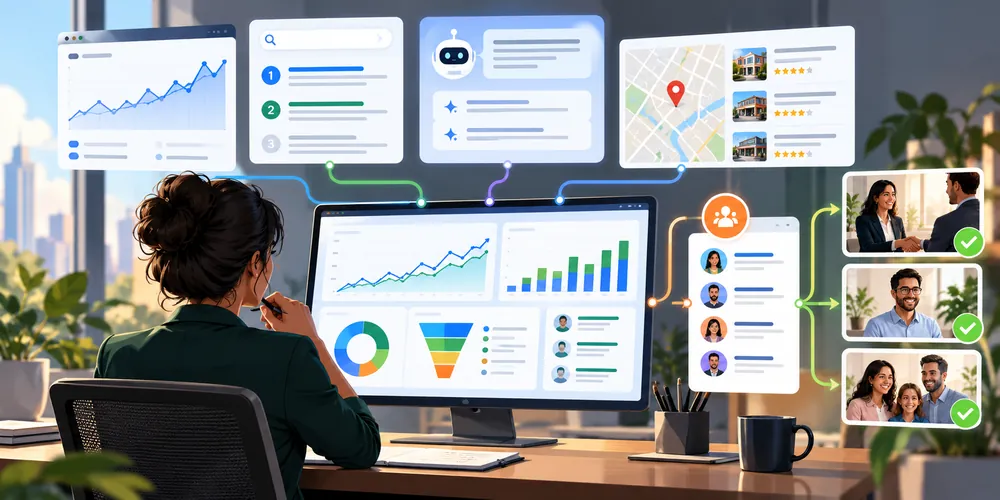
The right unit of analysis is the query and its intent, not the entire website. Consider four common patterns:
| Query pattern | Likely next need | Page or search asset to prioritize | Main risk |
| “What does a term mean?” | Quick explanation | Clear answer within a genuinely useful guide | The answer may be completed on the results page. |
| “Treatment A vs treatment B” or “software A alternatives” | Compare tradeoffs | Evidence-based comparison with real constraints | Generic comparisons can be summarized without a visit. |
| “Service provider in my area” | Verify proximity, fit and availability | Real location page, service page and eligible Business Profile | Inaccurate local details can lose the customer after visibility. |
| “Service cost, process or provider reviews” | Resolve a purchase concern | Pricing or process explanation, credentials and proof | Missing details send the buyer elsewhere. |
These patterns describe likely behavior, not rules for how Google will display each search in 2027. A phrase can trigger different features by country, device, location and time. Looking at the actual results for priority queries remains more useful than applying one prediction to an entire website.
A clinic, for example, might use an educational article to explain a condition, a treatment page to describe its care process and a location page to show where a consultation is available. A medical billing company might need a service page and a detailed explanation of eligibility verification or denial management. One generic blog cannot meet every stage.
When Does SEO Still Produce Commercial Value?
SEO has the strongest business case where the searcher has a problem the company can solve and a clear next decision to make. This does not mean every useful article needs an immediate sales pitch. It means each page should have an identifiable role in the customer journey.
Service and Product Decisions
A good service page states who the service is for, what it includes, how the process works, where it is offered and what happens after an inquiry. People comparing providers may need details an AI summary cannot confirm for a particular company.
Local Decisions
A nearby customer may want hours, directions, a phone number, reviews and actual service availability. Website pages and Google Business Profiles need to agree. Google describes relevance, distance and prominence as its main local ranking considerations; optimization cannot erase physical distance, but accurate information helps the customer choose once a business appears.
For businesses evaluating that path, the local SEO audit checklist covers both Maps visibility and what happens after a visitor clicks or calls.
Complex Research
An AI answer can summarize a subject, but a consequential purchase may require original testing, a detailed method, source evidence, examples and limits. A business that can provide those details has more to offer than a page repeating common advice.
Branded Verification
Someone who heard about a company through a referral or AI answer may later search its name. A clear About page, genuine reviews, consistent public information and relevant work examples help the person verify the provider. Branded search should be reported separately from non-branded discovery; otherwise referrals and advertising can be mistaken for SEO-driven new demand.
The Search Economics Behind Fewer Clicks
Traffic is an input, not the result the business buys. A simple way to evaluate a group of pages is:
Qualified customer outcomes = relevant visits × inquiry rate × qualified-lead rate × customer conversion rate.
This is a diagnostic relationship, not a Google ranking formula. A decline in visits can be offset by better-qualified searchers or a stronger booking journey. A rise in visits can be worthless if the new audience cannot buy. For local businesses, add calls and other Business Profile actions that may happen without a website visit; the website-only equation does not capture them.
Revenue analysis also needs context. Compare the value of a new customer, the cost of serving that customer and the ongoing cost of SEO work. Do not assign every sale to the last organic click when a buyer also saw a referral, an ad or a map listing. Conversely, do not credit SEO for all branded demand generated by other channels.
An SEO services plan should therefore define which service lines and locations matter, how qualified inquiries are identified and which outcomes can realistically be attributed.
Model 2027 Risk From Your Own Query Mix
The 58% decline observed in Ahrefs’ study is a finding about its sample, not a number to paste into every company’s forecast. A business can build a more useful range from its own data:
- Group important queries by informational, comparison, service, local and branded intent.
- Record each group’s recent impressions, clicks, landing pages and qualified inquiries. Note which queries commonly display AI answers or other prominent search features.
- Estimate outcomes under several plausible click-through rates while keeping lead quality visible. Do not assume all lost informational clicks would have become customers.
- Compare the result with Business Profile calls and later branded inquiries, which may not be credited to the first search encounter.
This analysis does not predict Google’s 2027 interface. It identifies which parts of the current search portfolio could become less valuable if clicks fall further and which pages still address a decision that requires contact.
How to Diagnose a Traffic Drop Without Guessing
If clicks fall, inspect the pattern before blaming AI. Google lists ranking changes, technical issues, security problems and demand changes among the possible causes of Search traffic losses.
| What you see | Plausible causes to investigate | First useful check |
| Impressions and clicks both fall across many pages | Indexing, site migration, demand, competition or a broader ranking change | Search Console page and query trends, indexing and recent site changes |
| Impressions hold steady but clicks fall on informational queries | Changed result layout, lower click-through rate or different titles | Compare the live results, device split and query-level CTR |
| Service pages lose impressions while articles remain stable | Competitor gains, page relevance, internal linking or technical problems | Inspect service queries and the preferred landing URLs |
| Traffic holds steady but inquiries fall | Page experience, form or call problems, weaker offer or different visitor mix | Test the full contact journey and review lead quality |
| Branded searches rise but non-branded discovery falls | Offline activity, referrals or paid campaigns masking SEO losses | Report branded and non-branded groups separately |
Average position is only a directional measure when query mix changes. Comparing a site’s total average position across two very different sets of searches can give the wrong impression. Review the same priority queries, countries, devices and landing pages across comparable periods. Use a longer window when volume is small and account for seasonality where relevant.
If an AI Overview appears for a query, record it as one part of the result layout. Do not treat its appearance as proof that it caused your entire decline. As you compare late-2026 data with 2027 results, test the competing explanations first and keep the query set, country and device mix as consistent as possible.
How to Measure AI Search Visibility Entering 2027
Google introduced a dedicated Generative AI performance report in Search Console in 2026. Its Search report shows impressions from AI Overviews and AI Mode and can be examined by page, country, device and date. Google says the insights were rolled out worldwide by August 31, 2026; a property may still lack a visible report if it has insufficient eligible impressions or is excluded from these features. That report offers a useful 2026 baseline for reviewing changes during 2027.
That report answers “Which pages were shown as links in Google’s generative search features?” It does not provide a separate, complete AI-only lead or revenue report. Google’s standard Web performance data still includes traffic from those features. Combine the reports with landing-page analytics, calls and CRM outcomes rather than treating AI impressions as customers.
There is also a Search Console control for whether a site’s links and content can appear in Google’s generative search features. The default is inclusion, but businesses should check the setting if visibility is unexpectedly absent. This control is separate from a promise to rank or be cited.
For more on what the reports show, see Google Search Console AI Mode and AI Overview tracking.
Outside Google Search, an AI assistant may cite a page, mention a brand without linking or omit it entirely. A small set of manually tested prompts can reveal inaccurate brand information or missing comparisons. Treat that exercise as a repeatable spot check: record the prompt, country, date, platform and answer. It is not a complete market-share metric, and citations can change between runs.
What Should an SEO Strategy Prepare for in 2027?
Google’s guidance available in October 2026 emphasizes pages that are discoverable, useful and distinctive. For its generative search features, a page needs to be indexed, eligible for a Search snippet and included under the site’s generative AI control. Beyond eligibility, no special markup guarantees inclusion. These are the current foundations to carry into 2027; any new feature or policy should be checked when it is actually released.
Give Each Intent a Clear Destination
A site may need one main SEO service page, a separate guide explaining whether SEO is still worth buying, a comparison of SEO and paid ads, and detailed pages for specific industries. Those pages answer different questions. Publishing multiple posts that all target the same “is SEO dead” intent can split relevance and confuse visitors.
The relationship between traditional SEO, answer visibility and generated responses is examined in this SEO vs AEO vs GEO comparison. A business can pursue all three outcomes through a coherent set of pages without writing three near-identical versions of every topic.
Supply Evidence That Cannot Be Easily Rewritten
Useful evidence may include a named expert’s reasoning, a real comparison method, current service details, screenshots from an actual workflow or a case study with permission. Explain what was measured and what remains uncertain. Do not invent before-and-after figures or treat an anonymous claim as proof.
For healthcare, finance and other high-stakes topics, review accuracy and credentials with particular care. E-E-A-T is a way to assess experience, expertise, authority and trust; Google does not describe it as a single score that can be raised by adding a badge.
Connect the Topic Cluster
An article about declining search clicks can link readers to a deeper AI Mode guide, a measurement article and a relevant service page. A service page can link to cases, process details and the issues buyers raise before contacting the business. Descriptive internal links show the relationship between subjects while giving readers a useful next step.
The site should not require a separate article for every synonym or question wording. Google says its systems can understand related terms and meanings. Build a new page when the intent, evidence or buyer decision is genuinely different.
Keep Critical Facts Consistent
Business names, services, locations and contact details should agree across websites and eligible local listings. That consistency matters when a prospective client searches for an SEO expert in Pakistan: the services, reviews and contact information on the listing should help them verify the provider before getting in touch.
Make the Next Action Work
A page can rank and still fail if the contact button is buried, the form is broken or the visitor cannot determine whether the service is available in their area. Test the phone, form, booking path and confirmation message on a mobile device. Record which service and location generated the inquiry without collecting unnecessary information.
Is Local SEO Dead?
No. Local search remains useful when someone needs a real nearby provider. Its performance depends on a different mix of factors from a national educational article: legitimate Business Profile eligibility, accurate details, proximity, reputation, relevant services and a website that helps the person decide.
A service-area business should not create fake offices to reach distant cities. A multi-location practice should distinguish real offices and the services available at each. A profile view, call or request for directions may create value without appearing as an organic website session.
This is another reason the question “is SEO dead in 2027?” needs a channel-specific answer. A decline in blog clicks during 2026 cannot, by itself, predict local appointment demand in 2027.
Is SEO Still Worth It Compared With Google Ads?
The two channels can serve different timing and intent. Paid search may place a new offer in front of buyers quickly while the budget is available. SEO can build useful pages and local visibility that remain accessible after a particular ad stops, although maintenance and competition continue. Neither channel fixes an unclear offer or a poor landing page.

Compare both using qualified inquiries and customer value. Separate campaign-generated branded searches from organic discovery where possible. If a business has urgent demand and no useful service page, improving that page may help both paid and organic visitors. If a low-value article attracts traffic but no prospects, publishing more similar articles is unlikely to solve the problem.
What Would Change the 2027 Outlook?
The evidence available today supports continued SEO investment for businesses with relevant search demand. During 2027, the conclusion should be tested against observable changes rather than defended regardless of results.
| Signal to monitor | What it could mean | Business response |
| Informational impressions remain strong while clicks fall | More questions may be answered on the results page, or competing elements may be drawing attention. | Review query-level results and invest in content that adds distinctive evidence or supports a later decision. |
| AI-feature impressions rise but service inquiries do not | The site may be visible as a source without helping qualified buyers take the next step. | Inspect the pages shown, their intent and the path to relevant services. |
| Service and local inquiries remain steady despite lower blog traffic | Traffic loss may be concentrated in research queries with limited commercial value. | Protect working service and local pages before spending to recover broad visits. |
| Qualified leads and bookings fall across service and local pages | Demand, ranking, competition, technical access or conversion may have changed. | Diagnose each cause with Search Console, listing actions and lead records before reallocating budget. |
The 2027 question is therefore testable: Are the pages that matter to customers still being found, trusted and used to contact the business? The answer may differ by industry and location.
A 90-Day SEO Plan for Entering 2027
Days 1–30: Establish What Changed
Identify the services, locations and customer actions that create value. Group late-2026 Search Console queries into branded, informational, comparison, service and local intent. Check the highest-value pages for indexing and contact problems. Review live results for a fixed set of important searches and save a baseline that can be compared with 2027 performance.
Days 31–60: Improve the Buying Path
Update the service and location pages with accurate scope, process, provider details and next steps. Strengthen comparisons with evidence and real limitations. Link supporting articles to the relevant destination. Correct eligible Business Profile details and test calls and forms from mobile devices.
Days 61–90: Compare Outcomes, Then Reallocate
Review the same query and page groups. Compare qualified inquiries and booked work alongside impressions and clicks. Use the generative AI impressions report to see which pages have appeared in Google’s AI features, while recognizing that impressions are not leads. Continue the changes that improved relevant outcomes; investigate failures before expanding the content calendar.
This is a review cycle, not a promise that Google will rank new pages within 90 days. When a result changes, note other possible causes such as seasonality, advertising, site releases and competitor activity. A before-and-after chart without those checks is weak evidence of causation.
Frequently Asked Questions
Is SEO dead in 2027?
Based on evidence available in October 2026, there is no reason to conclude that SEO will be dead in 2027. Google still relies on core Search systems for its AI features, and businesses still need to be found and evaluated. Actual 2027 performance should be judged by query intent, qualified leads and customer outcomes rather than traffic alone.
Has AI replaced SEO?
No. Google says its generative search features use core Search systems and established SEO practices. AI changes how answers and links appear; it does not remove the need for accessible pages, useful information and trustworthy business details.
Can you rank first and still lose clicks?
Yes. An AI answer or other result-page feature can satisfy a question before the user visits the top-ranking page. Changed demand, competitors and technical issues can also reduce clicks, so diagnose the specific query before assigning a cause.
Does a site need special AI schema or an llms.txt file?
Google says there is no special schema required for its AI search features and no need to create an AI-specific text file solely to appear in them. Suitable structured data can still describe visible page information and support other Search features.
Can I measure appearances in Google AI Overviews?
Search Console’s Generative AI performance report shows eligible impressions from AI Overviews and AI Mode, including the pages shown. It is a visibility report. Use standard Search performance, analytics, calls and CRM records to examine visits and business results.
Is blogging still worth the cost?
Yes when an article serves a question relevant to your customers and adds information they cannot get from a generic answer. A blog should connect to the right service or decision page. Volume alone is a poor reason to publish.
Is local SEO dead for small businesses?
No. Nearby customers still search for providers, hours, directions, reviews and available services. Local performance should include legitimate Business Profile actions and qualified calls as well as website traffic.
When should a business reduce SEO spending?
Reduce or redirect work when a topic consistently attracts irrelevant visitors, when the business cannot serve the demand, or when higher-value page and conversion problems remain unfixed. Base the decision on comparable periods and qualified outcomes, not one month of rankings.
Final Assessment
Is SEO dead in 2027? The evidence available before 2027 supports a more precise outlook: some searches already send fewer website clicks, especially when an answer is completed on the results page. Customers still look for relevant services and credible providers, and Google’s AI search draws on searchable web content. SEO will earn its place in a 2027 budget when it helps those customers find, evaluate and contact the right business.
If search traffic and inquiries tell different stories, examine the pages and queries behind each number. Waseem Marketing Expert can review search visibility, local presence and lead paths to identify where the next improvement is most likely to matter.
Research and Method Notes
Prepared in October 2026 as an outlook for 2027, this article draws on Google Search Central’s 2026 guidance for generative AI search and Search Console reporting; Pew Research Center’s July 2025 analysis of U.S. browsing activity; Ahrefs’ February 2026 comparison of informational-query click-through rates; and Seer Interactive’s April 2026 analysis of tracked brand queries. Their samples and methods differ, so the findings should not be treated as a forecast of 2027 click rates. Examples of clinics and service businesses are illustrative, not reported client results.